
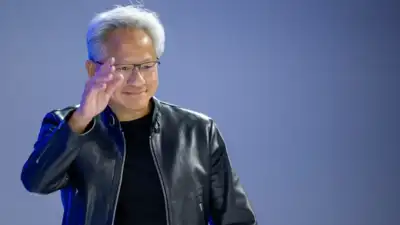
33 years to build Nvidia, five days to lose it
Then 2022 happened, to all of us and to Huang. Through an investment portfolio worth about $99 billion, he struck deals with nearly every company that had anything to do with artificial intelligence, from frontier labs to cloud providers, data centre builders and chip suppliers, and more than once with companies that then turned around and spent the money on Nvidia chips. Huang had been wearing one for at least 20 years, these days picked out by Lori and their daughter, Madison, and judging by his keynotes, it makes up most of his wardrobe. In July, one of them sold at Sotheby’s for $960,000, 16 times its high estimate, which tells you how the market was valuing anything Huang touched. By December 2023, he knew Alice Huang, a former Chinese TV reporter who ran one of Nvidia’s biggest customers in Southeast Asia. On November 8, he admitted to the affair. On November 12, he was out. Founders this powerful lose their companies only when they lose their boards, and by the night of November 11 Huang had handed Nvidia’s directors three reasons to let him go: his affair had become a national security question about Nvidia’s China business, he had built a company with no way to sideline him short of removing him, and he had broken a rule they could not look past. Her company, Megaspeed, was set up in Singapore in 2023 and went on to buy more than $4.8 billion worth of Nvidia chips from June 2024. Between June 2024 and June 2025 alone, one of its subsidiaries took delivery of more than 200 shipments of Nvidia equipment. The names already doing the rounds include Kress, Nvidia’s Ian Buck, Apple hardware chief Johny Srouji, AMD chief Lisa Su and Arm’s Rene Haas, who worked under Huang until 2013.
Because as late as November 9 his board, the president and half of Silicon Valley were still in his corner, the spy story alone didn’t do it,. Three relationships have been reported in little more than a week, and it would take a brave director to bet that the reporting stops here.
In private, according to people who have spoken with him, Huang has taken to calling himself a “piece of sh–. His main concern now, he says, is his wife. Thirty-three years. That’s how long Nvidia has existed, and how long Jensen Huang ran it. For most of those years, you could have sat next to him on a flight and not known who he was. Gamers knew the name on their GeForce cards, and the tech crowd knew the man behind them. Almost nobody knew that his wife, Lori, had given up her own chip design career at Silicon Graphics, where she was paid more than he was, so he could build the company. Artificial intelligence stopped being a lab experiment and became the thing every government, company and investor wanted a piece of, and nearly all of them needed Nvidia’s chips to get it. Huang’s early bets had put him right at the centre. Nvidia’s chips powered the boom, and Huang made sure Nvidia’s money did too. Nvidia became the most valuable company on the planet. Its CEO became a celebrity who could no longer walk through a trade show without being mobbed for autographs. The black leather jacket came along for the ride. Once he became famous, so did the jacket. Jensen Huang was now the man in the leather jacket. Plenty of CEOs have survived an affair. Plenty have not, and Huang now counts among them. Very few, though, have had one with an executive whose company was already under federal investigation for possibly smuggling their products into China. That is what set Alice Huang (no relation) apart. The search for a permanent CEO is now on, with the board looking at internal and external candidates. The list is starting to look as long as the shortlist for the next James Bond, and the speculation is just as loud. Whoever gets the part inherits the world’s most important artificial intelligence company, and possibly a few more headlines about the man who had it before. Huang is also expected to testify before Congress in the coming weeks, where the questions will be about Alice Huang and what she might have learnt about Nvidia’s chips. Join conversation Share your thoughts in the comments Be respectful · TOI community guidelines The leather jacket, mercifully, is not part of the package. Huang’s memo had ended with a request: “My family bears no responsibility for my choices. I do. Please give them privacy. That privacy will be hard to come by. Madison and Spencer still work at Nvidia.
By September 2025, the Commerce Department was investigating whether Megaspeed had helped smuggle restricted Nvidia chips into China. In June 2024, after Computex, the two drank whiskey with other artificial intelligence executives at a Taipei bar, and the photo ended up on LinkedIn, posted by a company called NetThunder. He was briefed in October 2025 and chose to do nothing. On November 8, the president said he had no regrets. He had been brushing off questions about it internally since late 2025, and as recently as October called the relationship “all completely normal and not unusual. It took a report on November 6 that the relationship was romantic, and a visit to his house from Nvidia’s general counsel, Tim Teter, for him to confess. His memo on November 8 opened with Lori and their children. He had more than 60 direct reports and a hand in every part of the business. In 2023, he said he could run Nvidia for another three or four decades. So on November 8, the board did the only thing its structure allowed. By November 9, analysts, investors and Elon Musk expected him to ride it out. Nvidia’s 10 board members had served a combined 161 years, many of them beside Huang since the 1990s, including the two venture investors who funded the company in 1993. The stock was down about a third from its early October peak, more than $1.5 trillion in value gone. On November 11, The Times reported, citing five people who worked at Nvidia, that Huang had also had an extramarital relationship with Kimberly Powell, the company’s vice president of healthcare, who reported directly to him. On November 12, Huang resigned as president, CEO and director, effective immediately. Investors were in no mood to mourn: the shares fell another 5.5 percent that day. Late on November 12, Reuters reported, citing two people familiar with the matter, that Huang had also had an intimate relationship with a second Nvidia employee. It took the company 33 years, and a scandal, to decide it needed one. Kress has called an all-hands meeting for November 18, the day after Nvidia reports quarterly results.
Because he never wanted one, there was no number two. Because it tied the directors’ fate to his, that arrangement could not last,. The New York Times later reported that a memo drafted under Secretary of State Marco Rubio this spring cited intelligence that she had been recruited by China’s Ministry of State Security to get close to Huang, learn about American artificial intelligence chips and nudge Nvidia to push for its most advanced chips to be sold to China. As the scandal grew, Bloomberg reported, the replies started to slow.
An online biography says she worked as a TV reporter in China, then at several major Chinese banks, before joining a Shanghai-based fund. China’s embassy has called the reporting “nothing but smears against China,” and she has not responded to requests for comment. “He dealt with somebody, but you know, so does everybody else,” he said. Representative Michael McCaul called it “a classic move from the CCP’s playbook” and wanted advanced chip shipments to China paused, and Senator Elizabeth Warren said Huang and the board “owe Congress answers. “I was unfaithful to my wife,” he wrote. Huang said he was “committed to protecting Nvidia and supporting America’s national security” and was “proud and grateful to be an American. Succession planning came up internally over the years, former executives have said, and Huang resisted it. Even after Huang confessed, most of the board did not want to take a public stance, according to people familiar with the matter. It opened an investigation into his dealings with Alice Huang, declared its “confidence in Jensen and his leadership team,” and left him running the company while it investigated him. Asked whether Huang should stay on, Trump said: “I think so. Alice Huang, meanwhile, had not said a word. Trump kept making that case, calling Huang an “honorable man” who didn’t know Alice Huang was a Chinese agent. “I just know he’s a fine person,” he said, “but you never know what’s going on. Earlier this year, Huang had told an interviewer that Lori had been “to every conference, every speech” of his career. “Every moment of Nvidia, she was there,” he said. Nvidia’s code of conduct tells employees to steer clear of conflicts arising from “personal relationships” and says the company “promptly investigates reports of misconduct. By the end of that meeting, Huang had been given no choice, and the man famous for his grip on every detail of Nvidia was, according to a person familiar with the situation, answering with “whatever” and “I don’t care. The announcement of his ouster thanked him for his “immeasurable contributions” and did not carry a single word from him, an unusual silence from a man whose keynotes routinely run past two hours. In his November 8 memo, he had told employees that leading Nvidia was “the privilege of my life” and promised to “work to earn back your confidence. Jones said the board expected Nvidia’s operations, customer commitments and product roadmap “to continue without interruption.
Megaspeed reportedly rented the computing power of its Southeast Asian data centres to Alibaba, giving China a back door to chips Nvidia cannot sell there directly. The network of companies around Alice Huang also had a financial link to China’s military establishment, through an investment in a cybersecurity subsidiary of China Electronics Technology Group, one of the country’s largest makers of military technology. Nvidia kept selling to it anyway, which, for a company that prides itself on seeing years ahead, was a remarkably short-sighted call. It was that investigation that led US officials to start watching Alice Huang, and in the course of that surveillance they found her in contact with Huang. Their meetings were hardly hidden. A year later, local media photographed her kissing him on the cheek at a dinner in the same city. Alice Huang herself is a different story. For a woman now at the centre of one of the biggest corporate scandals in years, remarkably little is known about her, and information on her background is largely absent from the Chinese internet. The man she is accused of targeting has fans wearing sweaters with his face on them, while she has managed to leave barely a trace. The agency she is accused of working for is run by Chen Yixin, who spent much of his career in Zhejiang, the eastern province where the network of companies around Alice Huang is clustered. In September, Chen wrote that China needed to assert control over artificial intelligence and that algorithms would help countries “gain the initiative on the battlefield. Those algorithms run on Huang’s chips. Set that against Huang’s last few years in Washington, where the leather jacket became a familiar sight at the White House and Lori a quiet presence beside him at state dinners. Trump had known for a year. Two months later, he approved the sale of more powerful Nvidia chips to China. In May this year, after Rubio warned officials about the relationship, Trump invited Huang to join him on a state visit to Beijing. Others were less relaxed. Until that week, Huang had denied any affair. “There is no excuse for what I did. Then it turned to Washington. Those are not lines a chief executive usually needs to put in an apology for an affair, and none of them could answer the question now hanging over every China decision he had touched. When a chief executive is caught in a scandal like this, there is usually a halfway step. He takes leave, a deputy runs the company for a few weeks, the board investigates, and everyone buys time. At Nvidia, that step did not exist, and Huang built it that way. His son, Spencer, and daughter, Madison, held senior roles in robotics and marketing, and his son-in-law worked in business development. His senior executives ran specific products and technologies, not divisions big enough to prepare anyone to run the whole company. Every employee filed emails listing their top five priorities, and Huang answered them at all hours. For a company selling the chips behind artificial intelligence that can supposedly do almost anyone’s job, Nvidia had made no plans for anyone to do Huang’s. It took Teter, who is also the board’s secretary, to tell them they had to. A company spokesperson added that Huang was “committed to continuing to lead Nvidia as CEO without interruption. Oh yes, sure. A board that close to its CEO, investigating him while he still ran the show, looked less like an inquiry and more like a family meeting. A class-action shareholder lawsuit was filed the same day. With no way to sideline him, the board was left with two options: stand behind Huang completely, or remove him completely. Huang had made sure there was no easier choice. What finally settled it had nothing to do with China. Until then, Huang’s defenders had one argument that worked: he was the victim here. A trained intelligence operative had gone after one of the most powerful men in technology. Even Trump, though, had left himself some room. The two were captured on video being affectionate at a San Jose hotel in March, during GTC, the Nvidia conference where Huang takes the stage in his jacket every year. Powell, who is married, has not responded to requests for comment. Judging the Alice Huang affair meant weighing intelligence the board could only see in pieces. The Powell relationship needed no security clearance. Many companies go further and bar managers from relationships with people who report to them outright. For the first time, the board had a case it could decide on its own terms, under its own rules. It also had the start of a pattern. One relationship can be written off as a lapse. A second, surfacing within days of the first, is what makes people start looking for more, the way two bees in the kitchen usually mean there is a hive somewhere close. The directors met remotely, late into the night. By then, the question in front of them was no longer just what Huang had done, but what else might still come out while he was in charge. The man in the leather jacket was just Jensen Huang again. Resigned is the polite word. He never got the chance. Within hours of the ouster, the board’s caution looked justified. Reuters did not name her, and she could not be reached. Nvidia declined to comment. Had the board kept him, it would have spent the week before earnings defending a CEO with three relationships to explain and a congressional briefing to attend. Instead, the report landed on a former chief executive. CFO Colette Kress will run the company while keeping her current job, and Harvey C. Jones becomes the first board chair in Nvidia’s history.
Four days earlier, the same word had been used to promise that Huang was not going anywhere.
In 2025, he persuaded President Donald Trump to roll back a ban and let Nvidia sell a less powerful chip there, then struck a deal to sell its second-most-powerful chip with the US government taking a 25 percent cut. At an industry awards dinner in 2021, Huang walked onstage with a bottle of red wine and two glasses while she stayed in the background, as she usually did. Today she is president of the family foundation, which held $9 billion in assets as of 2024, and co-trustee with Huang of a trust that holds more than half of his 922 million Nvidia shares. She also controls a separate trust with around $5 billion worth of Nvidia stock on her own. Huang no longer runs Nvidia, and with speculation already swirling about their 41-year marriage, what happens between him and Lori may now shape his stake in the company more than anything his board decides.
He was the industry’s most persistent advocate for selling artificial intelligence chips to China. He did draw a line, saying in May that China should not get Blackwell or the upcoming Rubin. All the while, he was in a relationship with the woman officials believed was sent to influence that very argument. Lori has spent four decades out of the spotlight. Your child uses AI every day. But do they understand it? Find out in the TOI AI Masterclass.