
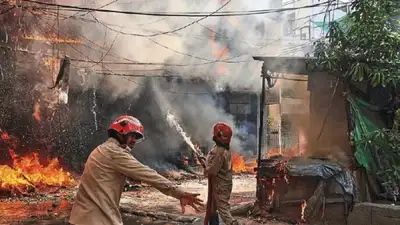
Hauz Rani fire in Delhi
The tragedy, which claimed 21 lives in Delhi’s Hauz Rani, has once again highlighted the dangers of being trapped in enclosed spaces during a fire. Oxygen levels in normal air are around 21%, but in a fire-hit enclosed space they can drop sharply, according to Dr Budhiraja. At least 10 police personnel and two fire personnels were taken to AIIMS Trauma Centre after suffering smoke inhalation, choking and breathing difficulties.
“When a person is trapped in a building that is under fire, most people die due to asphyxiation or suffocation,” said Dr Sandeep Budhiraja, group medical director at Max Healthcare who led the management of Wednesday’s incident. If rescue is delayed, severe lung injury follows and survival becomes difficult,” he said. Experts explain that as a fire spreads, oxygen levels inside rooms drop rapidly while smoke fills the air with poisonous gases such as carbon monoxide and hydrogen cyanide. “As temperatures rise, oxygen levels in the air fall. At the same time, smoke contains toxic gases such as carbon monoxide and hydrogen cyanide. The smoke itself is extremely hot and can directly injure the lungs. “The moment oxygen levels fall significantly, a person becomes disoriented and may lose consciousness. The dangers of smoke exposure were visible during the Malviya Nagar fire. Some also sustained injuries after falls during the rescue operation.
Some patients may initially appear stable but can deteriorate rapidly due to respiratory distress,” he added.
Dr Vishal Kumar, reconstructive and burn surgery specialist and former faculty member at GTB Hospital, said inhalation injuries often continued to worsen even after a victim has been rescued. “Hot smoke can cause swelling of the airway and windpipe, making breathing increasingly difficult.
“Carbon monoxide poisoning remains one of the commonest causes of death in closed-space fires,” said Dr Kuldeep Singh, burn and reconstructive surgeon at Apollo Hospital. “Carbon monoxide binds to haemoglobin much more strongly than oxygen, preventing oxygen from reaching vital organs. A person may become unconscious within minutes. Burning materials can also release cyanide compounds and other toxic gases that further impair oxygen utilisation. ”