
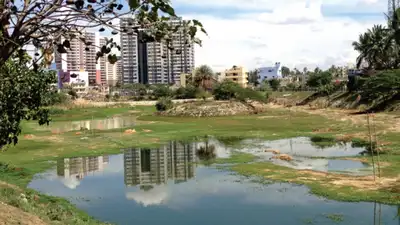
Photo: Bangalore’s Puttenahalli Lake
The findings, published in Frontiers in Water on July 30, 2026, look at an issue that has become increasingly important as Bengaluru tries to restore its lakes: is it enough to keep sewage out of one lake, or does the entire water system need to be considered? The study notes that diversion channels can therefore provide a local improvement while pushing the wastewater problem downstream.
Their average Water Quality Index score was **93**, which placed them in the study’s “Clean” category. The partially diverted lake also fell into the “Clean” category, with an average score of 83. For comparison, lakes receiving a mixture of treated and untreated wastewater had an average score of 67, classified as “Slightly Polluted”. The lakes without intervention scored an average of 56, placing them in the “Polluted” category.
A lake may look cleaner. The water may smell better. The black stream of sewage that once entered it may no longer be visible. But where did that sewage go? That question sits at the heart of a new study on Bengaluru’s urban lakes. Researchers who examined eight lakes in the city found that diversion channels can make a clear difference to the water quality of the lake they protect. At the same time, diverting wastewater does not make the wastewater disappear. It can move the problem further along the city’s drainage network. The study was conducted by Sumita Bhattacharyya, Priyanka Jamwal and Laurence Carvalho. The researchers compared lakes with diversion channels, lakes receiving a combination of treated and untreated wastewater, and lakes where there was no structural intervention at the inlet. The difference was visible in the water-quality measurements. The lakes with complete diversion channels had lower concentrations of several pollutants than lakes without intervention. The researchers measured parameters including dissolved oxygen, suspended solids, nitrogen, phosphorus, chemical oxygen demand and alkalinity. Seven parameters showed significantly lower concentrations in the lakes with complete diversion compared with lakes without intervention. The reason is relatively straightforward. During the dry season, diversion channels prevent untreated wastewater from entering the lake through the main inlet. But that is only one part of the story. A diversion channel deals with the immediate problem at the lake. It does not, by itself, treat the wastewater. In a city where lakes and drainage channels are connected, that distinction matters.
Based on interviews with fishing communities, the researchers recorded approximate weekly fish yields of 175 kg at Sarrakki and 75 kg at Jakkur. Sarrakki had been restored between 2020 and 2021 and had settling tanks and constructed wetlands at its inlets. Water samples were collected three times between February and July 2022, with sampling carried out after at least seven days without rainfall in the catchment.
Because wastewater treatment is not simply about installing a plant and moving on, this matters. The researchers therefore argue that lake restoration needs to be linked to the intended function of the lake and the wider catchment. The assessment therefore focused on pre-monsoon conditions. Because bengaluru’s lakes behave differently during the monsoon, when rainfall, runoff and inflows can substantially change the water system, that distinction is important.
You Can Also Check: Gold Rate in Bengaluru | Silver Rate in Bengaluru | Bank Holidays in Bengaluru | Public Holidays in Bengaluru | Bengaluru AQI | Weather in Bengaluru | Petrol Price in Bengaluru | Diesel Price in Bengaluru | CNG Price in Bengaluru | LPG Price in Bengaluru Stay updated with the latest Bengaluru news.
The comparison shows why simply asking whether a lake is “clean” may not capture everything that happens after a restoration project. Their water quality was better than that of lakes without intervention, although they remained in the “Slightly Polluted” category according to the study’s Water Quality Index. The researchers’ conclusion is therefore less about choosing between “diversion” and “no diversion” and more about looking at what the intervention is meant to achieve, what happens to the wastewater afterwards, and how the change affects the rest of the system.
But lower water availability during the dry months can also affect some of the services that a lake provides throughout the year. The researchers point specifically to activities such as fishing. Two of the lakes receiving a combination of treated and untreated inflows- Sarrakki and Jakkur- had active fishing during the period studied. Three of the lakes studied- Sarrakki, Hulimavu and Jakkur- received treated wastewater from sewage treatment plants as well as untreated wastewater entering through storm drains. It recorded better water quality than Jakkur. The researchers also noted that Jakkur’s treatment infrastructure had not been adequately maintained in recent years. The performance of the system also depends on how the infrastructure is operated and maintained. One of the more interesting points in the study is that there is no single intervention that serves every purpose. If the immediate objective is to prevent untreated sewage from entering a particular lake, a diversion channel can work. But a lake also has other functions. It may store rainwater, support aquatic life, provide habitat for birds and other species, contribute to groundwater recharge or support fishing. What works for one of these functions may not necessarily produce the same result for another. They identify effective wastewater treatment as the preferred long-term approach. They also suggest that additional measures, including constructed wetlands, may be needed in some locations to improve water quality enough to support biodiversity, fisheries and other ecosystem services. The researchers did not study the lakes throughout an entire year. The authors say this is an initial characterisation rather than a complete picture of how the different interventions perform across all seasons. The study does not say that diversion channels are a bad solution. Its findings show the opposite: they can substantially improve the water quality of the lake where untreated wastewater is being kept out. But the researchers also highlight the trade-off. If the wastewater is diverted rather than treated, it remains part of the wider urban water system. For a city with interconnected lakes, drains and catchments, that makes the question bigger than whether one lake looks cleaner after restoration. For Bengaluru, the cleaner lake may be the most visible result. The water flowing beyond it may tell the rest of the story. Download the TOI App.
Having more empty storage capacity before the monsoon can potentially help a lake accommodate incoming rainwater and runoff.
Because of a diversion channel, the researchers are careful not to suggest that every downstream lake will automatically become polluted. Because wastewater was no longer continuously entering them, the diversion-channel lakes had lower water levels during the dry season. Water quality depends on several factors, including the catchment, other pollution sources and what is already entering the water system upstream. But the basic problem remains: removing wastewater from one lake is different from removing pollutants from the water system. That distinction is particularly important in Bengaluru, where stormwater drains can also carry wastewater during dry periods. There was another difference between the lakes. That can have both advantages and disadvantages.