
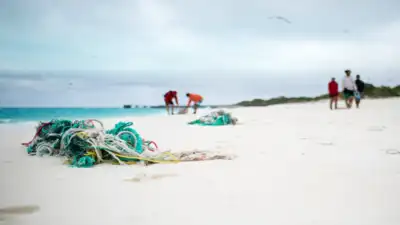
Fishing net on Hawaiian beach. Image credits: Wikimedia Commons
Researchers at Hawaiʻi Pacific University tested whether washed-up plastic could be melted into asphalt and returned about 11 months later to test whether the road was shedding microplastics back into the environment. As of the study’s presentation in March 2026, Hawaiʻi Pacific University reported the initiative had retrieved 84 tons of large fishing equipment from the Pacific. Science News separately reported a running total closer to 90 metric tons of plastic trash pulled from the ocean by that point, a discrepancy the two sources do not reconcile, and which may reflect a difference between short tons and metric tons rather than a factual error. Researchers return after 11 months to sample road dust for microplastics Instead of testing the pavement in the laboratory and calling it done, Lynch’s group let the road lie under normal traffic first. Around 11 months into the study, the researchers routinely swept up the road dust found in segments of asphalt pavement to see if the wear and tear had released microplastics into the dirt. But for a state running out of places to put its plastic waste, an 11-month road test that sheds no more microplastic than ordinary asphalt is a promising start.
CMDR has implemented an initiative known as the Bounty Program, whereby commercial licensed fishermen are rewarded for retrieving lost fishing equipment, according to Hawaiʻi Pacific University’s announcement of the project.
Tire wear swamps the polyethylene signal in the test results According to the American Chemical Society’s press release on the study, more work is needed on long‑term durability. Shipping waste off Hawaiʻi’s islands is expensive, local landfills are running out of room, and Pacific currents keep depositing tons of derelict fishing gear onto the shoreline. After the nets and plastic collected through the Bounty Program were processed for use in asphalt, the Hawaiʻi Department of Transportation moved the experimental mixtures onto a real road. The local construction firm poured pavement of a residential road on the island of Oahu using various mixtures of asphalt: the control sample using regular copolymer, a mixture using recycled polyethylene gathered from recycling bins in Honolulu and a mixture using recycled polyethylene from fishing nets. In the laboratory, the dust was processed to extract different types of polymer material, including microplastics, larger plastic fragments and tire-wear rubber. Researchers say conclusions do not answer every question about how the pavement holds up over years of use.

Hawaiʻi has been adopting polymer-modified asphalt since around 2020 for its improved resistance to cracking, rutting and water damage in the state’s tropical climate.
Jennifer Lynch, director of CMDR at Hawaiʻi Pacific University, says most debris in Hawaiian waters consists of fishing nets and fishing lines that drift in from elsewhere. That pavement is normally made by melting a virgin plastic copolymer into the asphalt binder before it is mixed with heated rock and sand.