
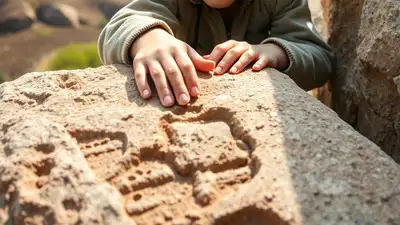
Representative Image of a child examining ancient fossil footprints preserved in rock in Mentougou, Beijing (AI-generated image)
In early 2025, 12-year-old Ni Jingchen was out exploring with his parents in Beijing’s Mentougou district when he noticed two tiny marks on a slab of exposed rock. Their analysis showed that the slab preserved a forefoot and hind-foot track made by a small amphibian roughly 160 million years ago, during the Middle Jurassic. Taken together, the evidence indicates that small, land-adapted amphibians lived in what researchers interpret as a lake-swamp environment in the region roughly 160 million years ago.
Ni already loved fossils and knew enough to realise that the strange impressions were worth a closer look, so he photographed them and shared the find online. He had no idea that his casual discovery would eventually bring professional palaeontologists to the site and reveal something scientists had never documented in Asia before. Associate professor Xing Lida of the China University of Geosciences in Beijing saw the photographs and organised a team to investigate. The animal most likely belonged to Salamandroidea, the group that includes modern salamanders, making Ni’s find the first scientifically described Jurassic amphibian track record from China and Asia. This remarkable find highlights how youthful curiosity and careful observation can meaningfully advance scientific understanding, proving that groundbreaking discoveries sometimes begin with everyday exploration. To extract as much detail as possible from marks barely larger than a fingernail, the research team used photogrammetric three-dimensional modelling to build high-resolution digital reconstructions of the tracks, allowing them to examine subtle surface features. The findings were formally published in the paper Possible caudata tracks from the Middle Jurassic Yaopo Formation in Beijing, China in the peer-reviewed journal Ichnos . After comparing the morphology of the impressions with known amphibian tracks, the researchers concluded that the trackmaker most likely belonged to Salamandroidea, a group that includes modern salamanders and related tailed amphibians. The tracks come from the Middle Jurassic Yaopo Formation, a coal-bearing geological unit in the Mentougou area that has also yielded plant fossils including ferns, ginkgoes and cycads.