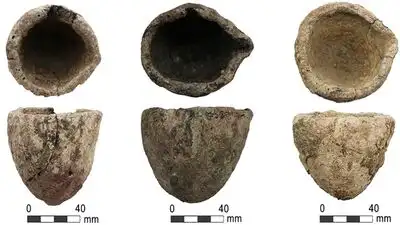
Archaeologists find the earliest physical evidence of brass-making in East Asia in southern China (PC: Cambridge University Press)
They measured about 60-80 mm across and 60-70 mm high, with a capacity of roughly 0.2-0.3 litres. One group of crucibles contained high-purity copper and binary brass droplets with about 11-17% zinc. The remains therefore show more than the presence of finished brass objects. Because these signatures occur widely across southern China, the researchers say a local source for the raw materials is reasonable. The researchers therefore suggest that maritime routes and the movement of merchants and craftsmen may have helped transmit brass-making knowledge to southern China.
Titled ‘ Brass technology transmission via maritime routes: crucible evidence from southern China ’, points towards wider technological connections with the Islamic world, according to a research article published by Cambridge University Press. A set of ancient crucibles found in Guangzhou is giving archaeologists new clues about how brass-making technology may have reached medieval China. The vessels came from an official metallurgical workshop at the Royal Palace of the Nanyue Kingdom and dated from the ninth and tenth centuries AD. Their metal residues show that craftspeople were producing brass locally through cementation rather than simply working with imported objects. Guangzhou was a major trading port, and the authors suggest maritime routes may have helped move metallurgical knowledge across regions. The study analysed crucibles using chemical, microscopic and lead-isotope methods. Together, the findings provide direct archaeological evidence for medieval brass production in southern China and offer clues about how the technology may have travelled. Archaeologists found three well-preserved brass-making crucibles at an official metallurgical workshop in Guangzhou. The workshop was part of the Royal Palace of the Nanyue Kingdom site and was active across many centuries. The three crucibles belong to the ninth–tenth century group. Each was cup-shaped with a slightly inward-sloping rim and a rounded base. Some had a pouring spout. Researchers found heavy heat damage and glassy material on their surfaces. Metal residues inside included copper, zinc compounds and brass droplets. A nearby semi-subterranean furnace also dates to the seventh-tenth centuries. Together, these remains provide direct evidence of metalworking at the site. Ancient crucibles reveal early brass-making in medieval China (PC: AI Generated) The crucial evidence came from residues left inside the crucibles. Microscopic and chemical analyses identified zinc oxide, zinc silicate, and droplets of brass. Another contained bronze with tin alongside zinc and produced a copper-zinc-tin alloy. The researchers interpret these residues as evidence for cementation. In this process, zinc-bearing material is heated with copper or a copper alloy so zinc enters the metal and forms brass. They preserve traces of the production process itself. The study also examined lead isotopes to investigate the likely origin of the raw materials. The three analysed crucibles had similar lead-isotope ratios that fit signatures associated with the Cathaysia tectonic province. The technology itself may have travelled from farther west. The authors point to similarities between the Guangzhou crucibles and brass-making vessels associated with the Islamic world. Guangzhou was also a major international trading port. Historical evidence records connections between the city and Arab merchants. The findings add important evidence to the history of brass production in China. Local brass production is generally thought to have begun around the tenth century AD, but the Guangzhou crucibles provide direct evidence from the ninth-tenth centuries. The researchers argue that the discovery helps explain how a specialised metallurgical technique became established locally. It also shows why archaeological workshops can reveal details that written records alone cannot provide. The study does not claim that every element of brass technology came from one place or through one route. Instead, it highlights a possible connection between western technological traditions, maritime trade and local production in Guangzhou. The evidence adds an important piece to the history of metallurgy in East Asia. Catch the latest World News and Live updates. Download the TOI app.