
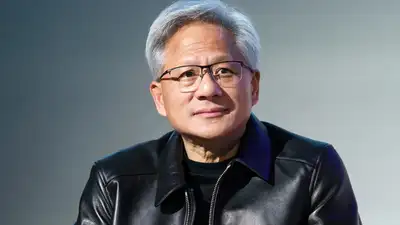
Jensen Huang
In 1993, three engineers sat over coffee in a booth at a Denny’s diner and sketched out their vision for a chip company. Jensen Huang, Chris Malachowsky and Curtis Priem had no way of knowing that the company they were about to build, Nvidia, would one day sit close to a 4.7 trillion dollar market capitalisation. Huang, now 63 and still Nvidia’s chief executive officer (CEO), believes the technology his company helped build has created an even bigger opportunity, not just for Nvidia, but for anyone thinking about starting a career or a company of their own.
“This is absolutely the single greatest time to start a company,” Huang said at Y Combinator’s Startup School 2026, in conversation with the accelerator’s CEO Garry Tan, according to Fortune . “The sense of vulnerability, the sense of uncertainty, the sense of insecurity,” Huang said on The Joe Rogan Experience last year, describing a feeling that has stayed with him through 33 years of treating Nvidia as though it were always 30 days from going out of business, according to Fortune. Huang’s confidence, he has said, comes less from having answers and more from being willing to find them.
Huang’s advice to anyone weighing a career risk is not about gathering more information or waiting for more certainty. It is about refusing to let the size of a problem become the reason not to attempt it. Three decades on, as demand for artificial intelligence (AI) chips has surged, that is roughly where the company stands today. He added that he was jealous of the opportunity sitting in front of young founders today.
Rather than mapping out every obstacle in advance and letting that exercise turn into anxiety, Huang suggested approaching new challenges with one question in mind: how hard can it be? The idea is to let difficulty arrive a little at a time, in place of imagining the whole climb before taking the first step. The advice sounds simple. What gives it weight is who is offering it, and what it has cost him to keep believing it. Huang’s optimism is not rooted in the belief that success comes easily. By his own account, he still works seven days a week and has spoken about running his company in a near constant state of worry over the possibility of failure. That admission matters for anyone weighing a career move of their own. A company now valued in the trillions is still, in the mind of the person running it, one misstep from collapse. If that feeling never fully leaves even at Nvidia’s scale, Huang’s point is that it should not be treated as a reason to wait for the fear to disappear before starting something. Early in Nvidia’s history, the company backed the wrong graphics technology and did not know how to correct course. Huang has recalled walking into Fry’s, an electronics retailer that has since shut down, with a few hundred dollars in his pocket, and buying three technology textbooks for his engineers to work through. Raising money and studying from textbooks were, in his telling, part of the same act of building the company, not separate from it. The lesson he draws from that memory is that technology keeps changing regardless of anyone’s plans, and that the ability to face that reality and keep learning matters more than the specific tools a person starts out knowing. For a career built in any field touched by AI, that is not a small distinction. Huang’s advice arrives at a moment when the case for starting something new does not look obvious on paper. Economic growth has slowed, conflict in the Middle East continues to weigh on markets, and AI is reshaping entire industries within months rather than years.
It is that the instinct behind it, facing reality and choosing to learn instead of waiting, is available to anyone willing to ask the same plain question he did in 1993: how hard can it be? Even so, business formation is running at a record pace, but that also means that not all optimism will be rewarded. That gap between enthusiasm and survival is why Huang’s advice reads less like a guarantee and more like a filter for how to think. His argument is not that starting something now is safe. It is that waiting for safety is its own kind of risk, one that guarantees nothing gets built at all. What began as a sketch over coffee in a Denny’s booth is now one of the most valuable companies on earth. Huang’s point to the next generation is not that the outcome is likely to repeat. Get the latest Education News and Live updates. Download the TOI app.