
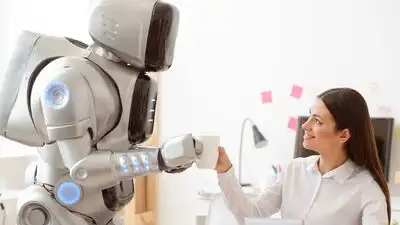
Ever tapped your card for a quick coffee or a bottle of water, only to have a digital screen turn toward you, silently pleading for a 20% tip? It is an awkward dance we have all performed lately. But the social tension reaches an entirely new level of weirdness when the entity asking for your spare change does not even have a heartbeat.
Ordering a $17 (£12.55) margarita brings the machinery to life—mixing tequila, lime, and triple sec, spinning for extra flair, and bowing as it delivers the glass. The real surprise comes on the receipt, which includes an additional 10% “service fee. digital prompts from automated machines leave consumers hesitating, unsure of who actually keeps the cash While tipping a human waiter 20% remains standard practice for most diners. Meanwhile, advocacy groups like One Fair Wage argue that deploying robots is merely an attempt to sustain low base wages, which currently sit at a federal minimum of $2.13 (£1.57) per hour for tipped workers compared to the standard $7.25 (£5.35) hourly rate.
Under federal law, owners and supervisors cannot take a cut of employee tips, but because a legal standard for who owns “robot tips” has not been formally established, a grey area remains. From cocktail-mixing mechanical arms in Las Vegas to automated coffee machines in New York, robot tipping is quietly sneaking into our daily lives. The trend leaves plenty of customers tapping their cards with a mix of confusion and guilt. After all, a machine does not pay rent, buy groceries, or feel the burn of an eight-hour shift on its feet. So when a touchscreen asks for a extra cash on behalf of a metal arm, where does that money actually go—and why are we being asked to pay it in the first place? If you are looking for entertainment at Las Vegas’s Venetian Hotel that does not involve slot machines, you might end up at a bar called The Tipsy Robot. Its main draw is two mechanical arms that mix automated cocktails. The machine, in essence, is asking for a tip. This scenario is becoming increasingly common across the United States. A robot barista prompts for gratuities at Artly Coffee in New York, while self-checkout kiosks at Newark Liberty International Airport suggest tips on a simple bottle of water. Across the country in Portland, Oregon, a human takes your order at Top Burmese, but a robot server wheels out the dinner. The primary question for confused customers is where that money ultimately lands. Representatives for both The Tipsy Robot and Artly Coffee state that their human staff split all collected tips, with the parent companies taking nothing. Artly has even disabled digital tip prompts at certain locations following customer complaints, opting instead for physical tip jars while maintaining that all tips go directly to human employees. Yet industry experts warn that these practices may be the exception rather than the rule. Holona Ochs, an associate professor of political science at Lehigh University and co-author of Gratuity , notes there is every reason to believe some employers keep robot tips for themselves. Combined with changes that make it harder for workers to pursue claims, the public has little way of knowing if companies are pocketing the money. The broader push toward automation and expanded tip prompts arrives amid shifting labor dynamics in the hospitality sector. Abigail Smathers, director of content at Artly, points out that technology helps address widespread labor shortages without displacing human workers. She notes that the technology’s morality lives in its intent and execution, adding that Artly gave its employees a raise alongside the removal of digital tip prompts. On the other hand, Katerina Berezina, an associate professor of hospitality technology at the University of Mississippi, suggests the hospitality industry deserves more credit. She explains that tipping or service fees can simply be a way to cover the labor and ongoing updates required to maintain the technology.
The display might have thrilled audiences two decades ago, but today it feels almost like a cliché.
Ultimately, the traditional motivations for tipping—rewarding good service, supplementing low wages, or avoiding social awkwardness—do not apply when interacting with a machine. Michael Lynn, professor emeritus at Cornell University and author of The Psychology of Tipping , argues there is simply no clear reason to tip a robot. Lynn believes the practice is deeply unpopular and likely temporary While studies show that consumers are far more open to tipping if they know the money supports behind-the-scenes human staff. If robo-tips end up driving customers away, businesses will eventually be forced to abandon the experiment altogether. Looking for trusted parenting advice? Follow TOI Parenting Circle on Instagram for expert guidance, relatable stories, and practical tips delivered every day.