
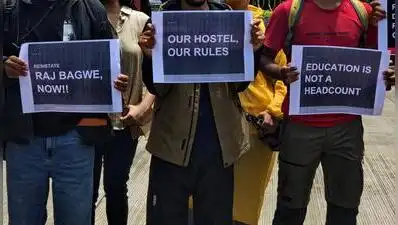
Students said they remained firm on their demand for an open forum to ensure individual representatives were not targetted
“It was communicated to the students that the director has invited talks with 3-5 representatives of the protesting students, but the students have not agreed to this as yet.
Pune: As the student protest at the Indian Institute of Science Education and Research (IISER) Pune entered its third day on Saturday, the institute issued a statement saying that director Sunil Bhagwat had invited three to five representatives for talks, but the students “have not agreed yet”. Speaking to TOI , students said they remained firm on their demand for an open forum to ensure individual representatives were not targetted. However, students said terms such as “unlawful” and “disruption” require clarification, as the institute’s disciplinary framework grants the director the authority to determine what constitutes indiscipline. Authorities clarified that while violations of institutional rules or Indian laws would be considered unlawful, participating in a peaceful sit-in would not be treated as a violation, according to the statement from IISER Pune. Hence, we are continuing our protest,” said one student.
The institute also noted that the protesters had not formally submitted their demands. They have also not shared their list of demands with the institute officially,” the statement read. The students, however, have sought a direct meeting with the director in an open forum with the entire student body, requesting that the meeting be recorded. “We want the director to have a direct conversation with all students so we can raise our issues together and ensure nobody is unnecessarily targeted. But, until now, that has not happened.
The students said they were collecting signatures and would submit a formal letter on Monday, ensuring the demands were not attributed to just a few individuals. Students claimed that an email sent on Friday evening by the administration stated the institute would not take disciplinary action against those participating in or organising the peaceful sit-in, provided it remains free from violence, does not disrupt essential operations, or involve “unlawful acts.