
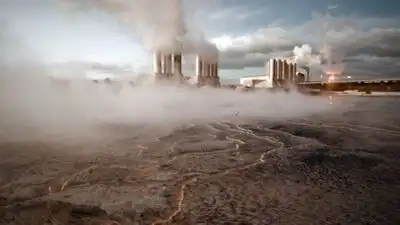
Quaise Energy, an American startup, announced on August 27 the final closing of a $180 million funding round, which included $35 million from Nabors, to finance the Obsidian Project in Oregon, where a microwave gyrotron will create wells in rock between 300 °C and 500 °C to establish the first commercial superhot geothermal plant on the planet, as per a report by ThinkGeoEnergy.
The Series B totals $180 million, bringing the startup’s total funding to $280 million since its inception, according to the statement. The first tranche, amounting to $134 million, was previously announced on July 7, led by Prelude Ventures with participation from Japanese companies JERA and Idemitsu Kosan. The new addition to the list is Nabors Industries, one of the largest oil and gas drillers in the world, which contributed $35 million and signed a strategic agreement. Engineer Paul Woskov from MIT’s Plasma Science and Fusion Centre spent 14 years testing the concept of directing this beam downwards, according to MIT News.
Nabors will provide a dedicated land rig and integrate its reservoir modelling platform, well design, and drilling strategy into the project, according to the release. In other words, the oil and gas industry is lending a rig, software, and personnel for a technology that promises to eliminate the need for a drill bit. A gyrotron is a millimetre-wave generator, a high-frequency microwave technology created to heat plasma in nuclear fusion reactors. His description is straightforward: these are very powerful beam sources, akin to lasers, but at a different frequency range.
The company drilled over 100 meters of granite at a test site in Central Texas, and is now approaching 1 kilometre in depth at the same location, which it refers to as the deepest feat achieved by contactless drilling, according to Quaise’s July update. The leap from there to more than 5 km in Oregon is substantial, and the company acknowledges this in its timeline. In practice, the beam travels down a waveguide to the bottom of the well, heating the rock to the point of melting and vaporising it without mechanical contact. There is no rotating drill bit or carbide teeth wearing away. The company defines the process as rock ablation with zero contact, and that’s where the advantage lies. The deeper you go, the hotter and harder the rock becomes; this is precisely where traditional drilling begins to fail.
Why a superhot rock
The thesis of superhot geothermal energy is different: to descend to where rock exceeds 374 °C and water reaches a supercritical state, which carries far more energy per kilogram than regular steam. Quaise targets rock at temperatures between 300 °C and 500 °C and at depths that, in most parts of the world, exceed 5 km. It spans 1,334 acres within the Deschutes National Forest, featuring a geothermal gradient of about 100 °C per kilometre. In other words, temperatures that elsewhere would require 10 kilometres of drilling are found there at a fraction of the depth. The target reservoirs for Phase I are described at 315 °C and 365 °C. Phase I is set to deliver 50 MW, with power expected on the grid by 2030; Phase II aims for 250 MW, with the company discussing gigawatt-scale in the long term. For now, the initial wells employ conventional drilling to penetrate the surface layer; the gyrotron will only come into play when the goal is the hotter basement rock at 365 °C, as Quaise explained to the publication. Soviet scientists began in 1970 and reached 12,262 meters by 1989, making it the deepest hole ever drilled, with just a 23-centimetre diameter. Temperatures at the bottom exceeded 180 °C, well above what models predicted. Kola took nearly two decades to traverse 12 kilometres in still relatively cool rock.
Because there is little hot rock near the surface, the country hardly explores geothermal energy, partly. The project was abandoned in 1994 due to lack of funds and drill bits capable of withstanding the conditions.
The area leased by Quaise lies south of the Newberry volcano, right next to the border of the Newberry National Volcanic Monument, according to ThinkGeoEnergy. Traditional geothermal energy works with hot water or steam at moderate temperatures, near volcanoes or geological fault lines. Thus, a single superhot well can deliver several times what a conventional geothermal well produces. What makes Oregon special is the gradient. The plan published in April outlines two sets of wells, each with one injector and two producers, and two generating units connected side by side. For Brazil, the interesting development is Nabors’ entry. The drilling company operates rigs in various markets, and the combination of a conventional rig for the shallow part with a gyrotron for the hot section is a model that could operate in any sedimentary basin with a favourable gradient, without relying on a volcano. If the technology proves successful, depth will no longer be an obstacle, and what will matter is having the rig, team, and regulations ready. Anthony Petrello, president and CEO of Nabors, summarised the logic in the statement by saying that millimetre wave technology changes the equation by reaching superhot rocks at depths beyond the reach of conventional methods. Carlos Araque, CEO and president of Quaise, spoke about unlocking the world’s most powerful clean energy source. A discussion about deep drilling inevitably references the Kola Superdeep Borehole in Russia. What halted progress was not the rock, but the heat. Under those conditions, the rock behaved more like plastic than solid. It’s clear why the idea of vaporising rock instead of scraping it generates such interest. Quaise aims to work in rock three times hotter, arguing that millimetre waves are unaffected by the target’s hardness or temperature. It’s a bold promise, and the company still needs to prove that the beam remains stable and efficient well beyond Texas tests. Catch the latest World News and Live updates. Download the TOI app.