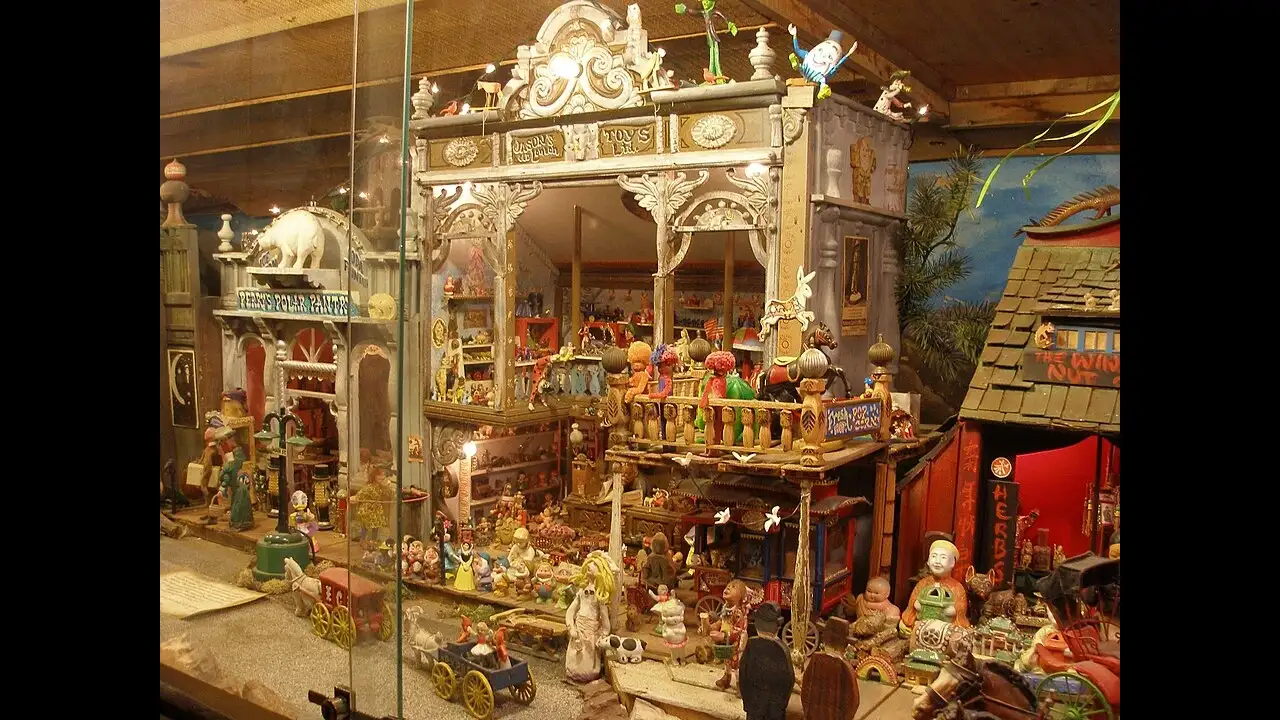
Ross Ward spent 40 years hand-building Tinkertown from carved wood. Image Credits: Wikimedia Commons.
In 1962, self-taught artist Ross Ward began carving small wooden figures as a hobby, initially creating scenes that could travel with him to fairs and carnivals. The museum opened to the public in 1983 and had grown from Ross Ward’s small summer cabin into a 22-room collection of handmade displays, according to Tinkertown Museum . Its winding spaces contained an animated miniature Western town, a detailed circus, coin-operated attractions such as Otto the One-Man-Band, collections of antique tools and dolls, thousands of wedding-cake figures and the 35-foot antique sailboat Theodora R.
The museum therefore became as much a record of his interests as a display of his craftsmanship. A childhood fascination with miniature figures eventually became one of New Mexico’s most unusual folk-art attractions. Over the next four decades, the hobby expanded into an elaborate handmade world at Sandia Park, where thousands of carved characters, animated displays, collections of Americana and walls made from tens of thousands of discarded glass bottles eventually became Tinkertown Museum. By then, what had begun as a travelling collection had become a permanent environment that combined Ward’s carving, mechanical work, collecting and construction. He spent much of his adult life carving, painting, collecting and constructing, rather than producing a single finished work for a gallery. His attraction to the Old West, travelling shows and everyday American life was reflected repeatedly in both the carved scenes and the objects surrounding them. The building’s handmade character also placed Tinkertown within the tradition of self-taught and outsider folk-art environments, where artists transformed private properties into immersive spaces rather than creating isolated artworks.