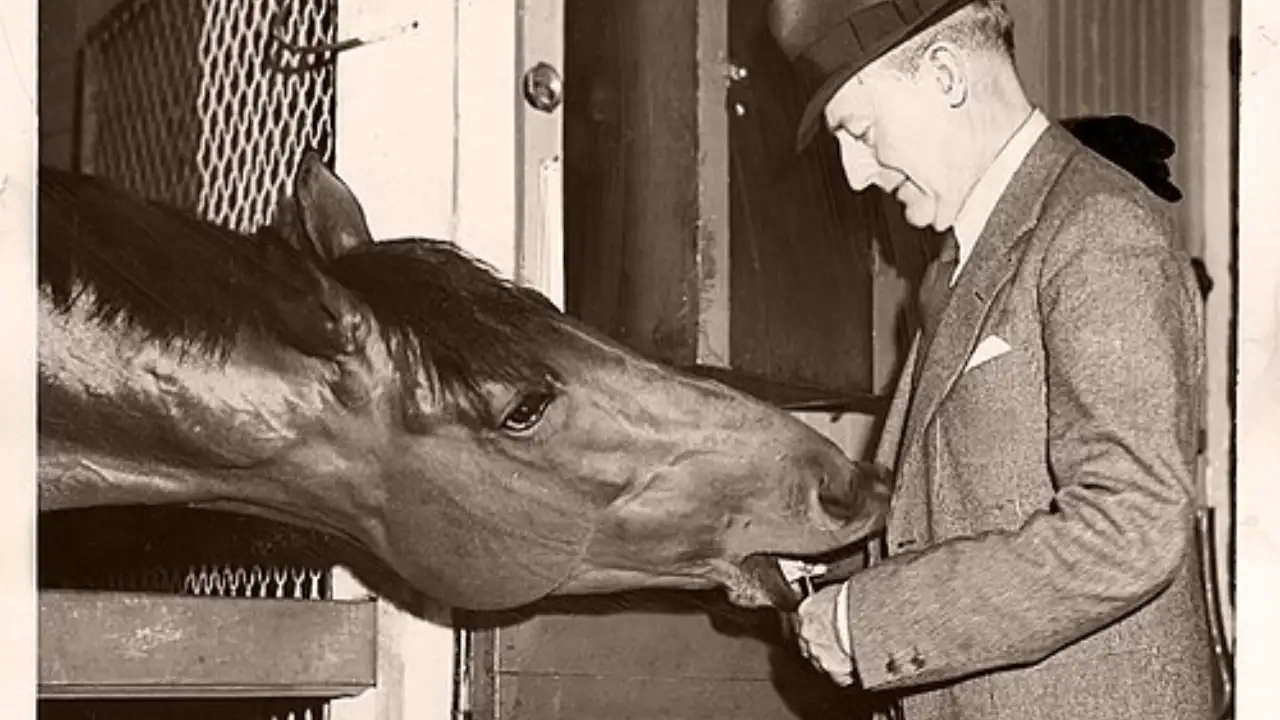
George Woolf on Seabiscuit (Image: Wikipedia)
After a remarkable racing career, the champion arrived at the ranch in 1940, where he lived until his death in 1947. In the early 2000s, preservationists and landowners were working to protect more than 4,600 acres of the remaining ranch from development. At the time, plans called for more than 4,600 acres of the remaining ranch to be placed under permanent conservation protection, safeguarding open space and working farmland from development. The Mendocino Land Trust says it now holds two conservation easements at Ridgewood, one protecting 33 acres of old-growth and large second-growth redwoods, and another permanently protecting 1,689 acres of oak woodland habitat. His stud barn, where he spent his retirement years, was restored and added to the National Register of Historic Places in 2014.
Because they provide important ecological and wildlife habitat, these measures mean Ridgewood’s value is no longer limited to its historical association with a famous racehorse; parts of the landscape are protected. For years, Ridgewood Ranch in Mendocino County, California, was known primarily as the place where Seabiscuit, one of America’s most famous racehorses, spent his retirement. But the property’s importance extends far beyond its connection to a legendary horse. Its rolling oak woodlands, redwood forests, streams, wetlands and working farmland have also made it an important landscape for wildlife and conservation. The push to preserve Ridgewood gained momentum through partnerships involving the landowners, the Mendocino Land Trust and other conservation organisations. The conservation effort eventually produced specific easements covering important portions of the landscape. The Seabiscuit Heritage Foundation also records protected streams, tributaries, riparian habitat and wetlands across the ranch. Its protected habitats include oak woodlands, redwoods, rangeland, seasonal wetlands and waterways that support species such as steelhead, golden eagles, great blue herons, bears, mountain lions, foxes, deer and yellow-legged frogs. Seabiscuit’s legacy is preserved alongside that natural environment. The ranch remains a working landscape rather than a conventional museum, while visitors can learn about its history through tours and preserved buildings. In this way, the land that once offered Seabiscuit a peaceful final chapter has become something larger, a place where a celebrated sporting story and a valuable California ecosystem continue to survive together.
Today, Ridgewood continues to carry both its historic and environmental legacy, with conservation easements protecting important habitats and historic structures preserving the memory of Seabiscuit and the Howard family. Today, Ridgewood Ranch represents an unusual meeting point between sporting history, working agriculture and environmental conservation.