
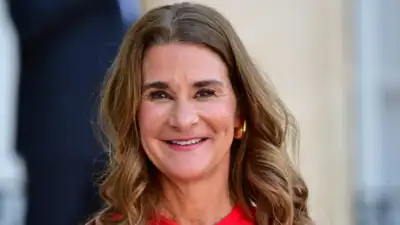
Melinda French Gates has spent her career around the language of scale — grants, foundations, billions of dollars moved toward global problems. It would be easy for someone in that position to talk about impact only in the vocabulary of metrics: lives reached, doses delivered, dollars deployed. Instead, in The Moment of Lift, she chooses to define her life’s work through a word most public figures avoid entirely. She does not soften it or qualify it. She builds a definition around it and then tells you where it starts.
Because lifting someone’s self-image rarely looks like a grand gesture, the quote is easy to nod along to and harder to apply,.
By putting “effort” at the center of the definition, Gates is quietly ruling out the version of love that only shows up when it is convenient. Gates has said she borrowed part of this idea from the Franciscan priest Richard Rohr, who told her that only love can safely handle power. “For me, love is the effort to help others flourish, and it often begins with lifting up a person’s self-image. The quote does two things, and it does them in order. First, it defines love not as a feeling but as an effort — something closer to labor than sentiment. That is a deliberate choice. Feelings arrive and pass on their own. Effort has to be chosen, repeated, sustained on the days it produces nothing visible. Second, the quote locates where that effort has to begin. Not with resources. Not with solutions. With self-image. That is a specific and almost counterintuitive claim. It would be reasonable to assume that helping someone flourish starts with giving them something — money, opportunity, a seat at the table. Give someone an opportunity before they believe they deserve it, and they may not take it. Help them see themselves differently first, and the opportunity has somewhere to land. There is a word doing quiet work here too: “often. Not always, not by definition — often. Gates is not claiming a universal formula. She is describing a pattern she has watched repeat itself enough times to name it. That restraint is part of the voice. The claim is confident without overreaching. It is not a small thing for someone who has controlled billions of dollars in philanthropic capital to say that power without love is dangerous, and to mean it as a working principle rather than a nice sentiment for a book jacket. The self-image half of the quote is not abstract for her either. She has spoken about arriving at Duke as one of a handful of women in computer science classrooms, and later at Microsoft, in a culture she has described as brash, where her own confidence took a hit before it recovered. She did not come to the idea that self-image precedes flourishing from a distance. She came to it from having had her own self-image tested and rebuilt. It also shows up in the shape of her philanthropy. Decades of work with women in Sub-Saharan Africa and South Asia convinced her that access to contraception, credit, or education did not automatically translate into a different life, unless it arrived alongside something harder to fund: a woman’s belief that she was allowed to want more for herself. That is why so much of her later work, through Pivotal Ventures, is aimed at women’s confidence and leadership specifically, not only at the material conditions around them. It looks like noticing a person’s competence before they trust it themselves. It looks like handing someone responsibility slightly ahead of when they feel ready for it. Gates is not describing a feeling you wait to have. She is describing a practice you start with the person in front of you, before you get to anything else. Get the latest technology news and updates. Download the TOI App.
Gates is saying it starts earlier than that, with whether a person believes they are someone worth investing in to begin with. It looks like the small, repeated choice to treat someone as capable, before the evidence has fully caught up.