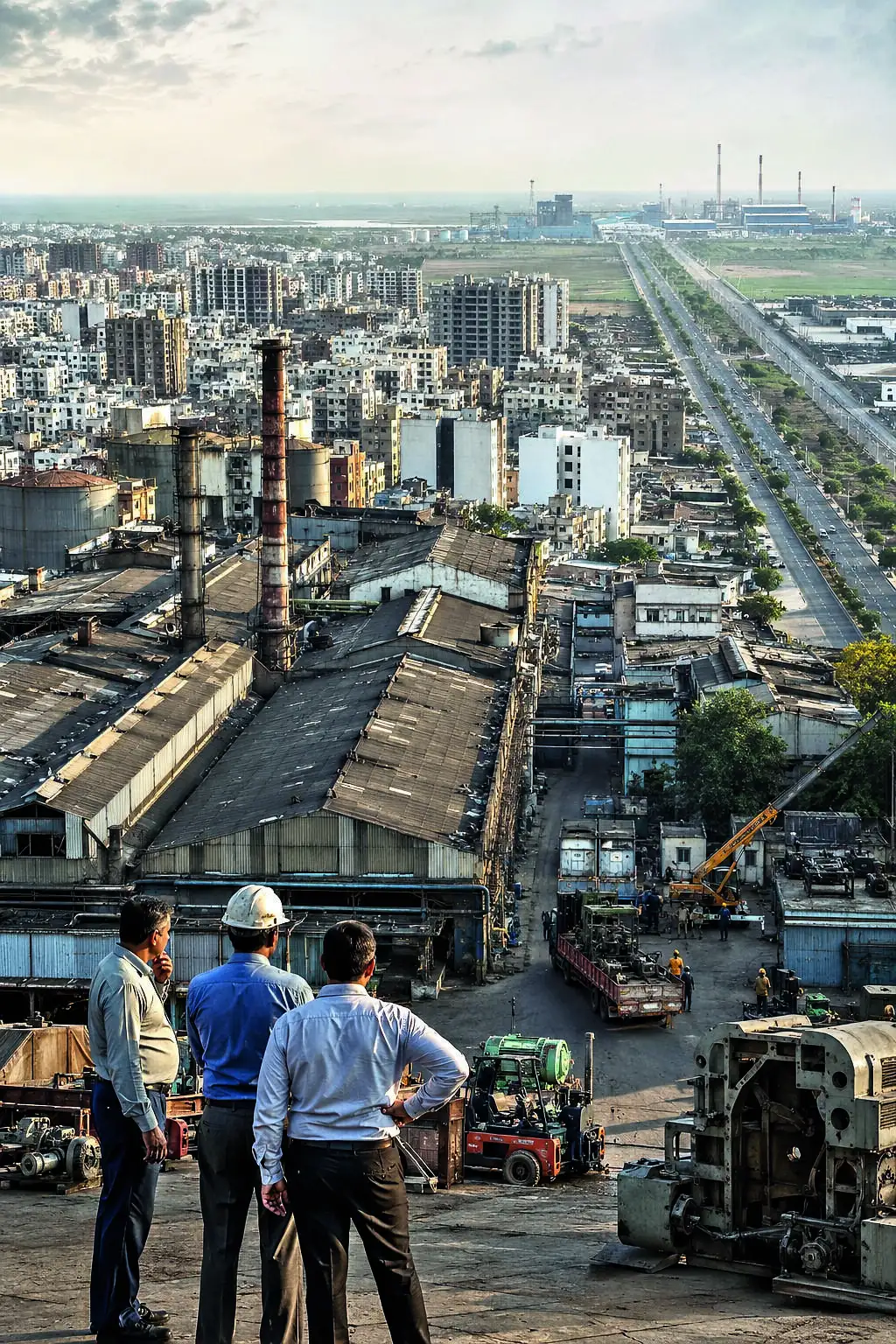
Manufacturers say the shifting will involve substantial cost and new units cannot start operations until the new ecosystem is set up completely
Ahmedabad’s industrial landscape has changed sharply over five decades. GIDC estates such as Vatva and Naroda were developed on the city’s outskirts to keep manufacturing away from dense habitation. Urban expansion has since surrounded these clusters with residential and commercial development. The clusters are now weighing Gujarat’s push to move industries outside city limits, but high relocation costs are making businesses cautious.
The state plans to stop expansion permissions for polluting industries within Ahmedabad and require their relocation outside the urban area by 2030, according to sources. The proposal could affect nearly 5,000 units across Naroda, Vatva, Odhav and Kathwada, covering textiles, engineering, chemicals, dyes and intermediates. “There are around 1.50 lakh micro and small manufacturing units across chemicals, textiles, plastics, engineering, pharma, foundries and other sectors in Ahmedabad. There are plans to shift the units by 2030 Naroda GIDC : How the city grew around industry Naroda GIDC illustrates how Ahmedabad’s industrial landscape has changed. Practically, shifting could mean 75% of the units shutting down,” Patel said. Vatva has around 400 chemical units, including those serving the food and pharmaceutical sectors, besides ancillary and engineering businesses. Many operate on compact plots, ranging from 50-yard sheds to units spread across 2,000-3,000 square yards. An estimated cost for a typical factory could be Rs 15 crore, excluding land, to relocate. Narol Textile Infrastructure and Enviro Management (NTIEM) had proposed setting up a 2,000-acre Textile City outside Ahmedabad around three years ago. About 125 textile processing units in Narol, Shahwadi and Piplaj process nearly 2,800 million metres of fabric annually, generate around ₹10,000 crore in revenue and employ about 1.5 lakh people.
Industry leaders weigh in You Can Also Check: Gold Rate in Ahmedabad | Silver Rate in Ahmedabad | Bank Holidays in Ahmedabad | Public Holidays in Ahmedabad | Ahmedabad AQI | Weather in Ahmedabad | Petrol Price in Ahmedabad | Diesel Price in Ahmedabad | CNG Price in Ahmedabad | LPG Price in Ahmedabad Stay updated with the latest Ahmedabad news.
Ajay Patel, chairman of the GIDC committee of GCCI, said relocation could not happen overnight. The state must ensure a smooth transition,” he said. Relocating the polluting units out of these them will be a tough task,” said an office-bearer of FICCI Gujarat Council. However, over the years, the city has grown rapidly and now these estates are part of the city,” said Shailesh Patwari, former president of GCCI. Industry says that any relocation will depend on reliable power, water, effluent and waste systems, roads and logistics at new estates. Many countries have seen this with the development of cities,” a leading industrialist said. Ankit Patel, national vice-chairman of Chemexcil and chairman of Vatva CETP Green Environment, said similar relocation provisions featured in the previous industrial policy too. “The latest policy has not come to the fore yet, so we do not know what is being offered,” he said. The proposal poses a particular challenge for micro and small chemical units in Vatva, Odhav and Naroda, industry players said. “If units move individually rather than as a cluster, they will lose proximity to suppliers, ancillary manufacturers and customers,” said a chemical industry player. “For SMEs, shifting is impossible,” said another industrialist. This makes relocation more complex than for engineering units, where equipment is relatively easier to move,” Patel said. If units move far from residential clusters, employers may have to bear transport costs, deal with attrition or support housing,” an NTIEM office-bearer said. Gaurang Bhagat, president of Maskati Cloth Market Mahajan, said relocation could help modernise Ahmedabad’s textile industry if backed by incentives. “However, the industry must be given enough time if relocation is planned,” he said. If it remains voluntary, very few units in existing clusters are likely to relocate, as most are MSMEs,” said an office-bearer of the Gujarat State Plastic Manufacturers’ Association.
The move aims to reduce urban pollution and ease infrastructure pressure, with relocation incentives proposed under Project THRIVE. The scheme offers higher floor space index, waivers on conversion and FSI-change charges, wage support and assistance for industrial parks and common environmental infrastructure. Industry representatives say shifting established units would require substantial investment in land, buildings, machinery and infrastructure. They also want clarity on new industrial locations, environmental facilities, labour availability and connectivity with existing supply chains. “Relocation is not just packing up and moving. First, new units have to be constructed and production has to begin gradually. Industries must ensure raw material supply and manpower availability at the new estates. Only once the ecosystem is established can existing units be shut. businesses remain wary of the costs, timelines and operational risks While industry acknowledges the need to move some manufacturing activities away from dense urban areas. SMEs fear disruption to production, supply chains and employment. “When Ahmedabad GIDC estates like Vatva and Naroda were set up, they were around 20km away from the city. Ancillary services and last-mile connectivity will also be critical. At the same time, some industrialists see relocation as inevitable as cities expand. “Relocation is inevitable. Chemical units face the toughest equation For chemical units in Ahmedabad’s established industrial clusters, relocation is less about incentives and more about viability. “Unlike larger companies, SMEs cannot easily bear the cost of setting up a new facility, shifting machinery and rebuilding infrastructure. For chemical units, water and effluent management add to the challenge. A scattered relocation could also disrupt established supply chains. Water, common infrastructure and labour availability are among the biggest hurdles. New industrial locations would need common facilities before units can shift. Skilled and semi-skilled workers would also have to be mobilised to the new locations. “Locations such as Dahej could work for large chemical manufacturers but would be impractical for many Ahmedabad-based micro and small units. The capex burden is another constraint. “Chemical plants also have fixed structures and machinery that are expensive and difficult to dismantle and reinstall. Textile units seek clarity before committing to relocation Labour and supply-chain disruption are key concerns for Ahmedabad’s textile industry as the state weighs relocating industries outside city limits. Units in Vatva, Naroda, Odhav, Kathwada, Narol, Piplaj, Shahwadi, Behrampura and Danilimda rely heavily on workers living nearby. “There is no clarity on whether govt will order relocation in the coming years. We need clarity soon. Manufacturers also fear disruption to established vendor networks. Suppliers and service providers currently operate close to factories, allowing faster turnaround and flexible production. Plastic units may ask for phased transition Industry associations are seeking clarity on THRIVE’s eligibility, incentives, land availability and implementation timeline, along with assurances on utilities and approvals. The scheme aims to encourage industries to voluntarily relocate from congested city limits to planned industrial estates, offering capital assistance, wage support, higher FSI and common infrastructure support. “Formal notification has not been issued yet. Plastic manufacturers are also likely to seek a phased transition to minimise production disruptions, protect employment and avoid sudden compliance costs. Download the TOI App.