
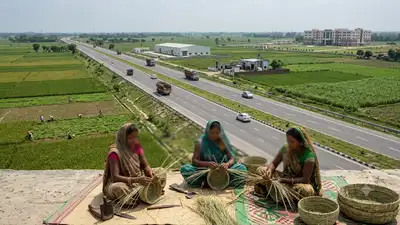
AI generated image
However, the period since 2017 under Yogi regime has brought a visible shift in its development trajectory. Because it is not based on a single project, the transformation is significant. Sultanpur, a politically talked-about eastern-central district of Uttar Pradesh, has emerged as an important example of how infrastructure-led development can reshape the economic and social profile of a traditionally agrarian district. Major expressway connectivity, new industrial possibilities, the promotion of traditional crafts, expansion of healthcare and medical education, and a fresh round of public investment have together begun integrating Sultanpur more closely with the wider economy of Uttar Pradesh. Rather, Sultanpur’s development story reflects the convergence of roads, industry, rural enterprise, healthcare, education and public infrastructure. The district is increasingly being positioned not merely as a transit point between Lucknow and eastern Uttar Pradesh, but as a potential centre for investment, employment and services.
Sultanpur has historically depended heavily on agriculture, small trade and traditional occupations.
The expansion of medical and nursing education can therefore contribute both to better healthcare delivery and to the creation of skilled employment. More importantly, the expressway has created the foundation for future economic activity. Roads by themselves do not automatically create industrialisation, but they reduce one of the biggest barriers to investment—high logistics costs. Sultanpur is now better positioned to convert its connectivity advantage into employment and enterprise. The next stage of Sultanpur’s transformation is expected to come from industrial development along the Purvanchal Expressway corridor. The state government’s efforts to develop industrial clusters and attract investment are particularly important for a district where a large section of the population has traditionally depended on agriculture or migrated in search of employment. Improved road connectivity can support manufacturing units, logistics centres, warehouses, food-processing enterprises and small and medium industries. Sultanpur’s location between the state capital and eastern Uttar Pradesh provides an additional advantage for businesses seeking access to a wider consumer market. The development of industrial infrastructure along the expressway has the potential to create employment opportunities closer to home. This is especially significant for young people who have traditionally had to move to Lucknow, Delhi, Mumbai or other cities in search of work. The larger objective is to create an ecosystem in which infrastructure attracts investment, investment creates jobs, and jobs increase local purchasing power. Over time, such a cycle can stimulate the growth of housing, retail, transport, education and other service sectors. This is particularly important for women and rural artisan families. Craft-based enterprises can often be developed with relatively low capital investment and can provide supplementary or independent income within villages. Organisations working with artisans have also contributed to skill development and the expansion of market opportunities. The proposed development of nursing education infrastructure is another important step. Healthcare requires not only doctors but also nurses, technicians and a wide range of skilled professionals. This investment in human capital has a long-term economic significance. Educational and healthcare institutions generate direct jobs while also supporting hostels, housing, transport, food services and other local businesses.