
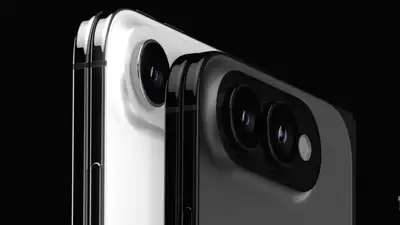
Apple iPhone Ultra in the rumoured white and black colour options (Credit: Front Page Tech)
That is close to double the $1,199 iPhone 17 Pro Max. TrendForce expects a softer entry point of $2,099 to $2,299, or about Rs 1.85 lakh to Rs 2.03 lakh, while Citi has settled on a $2,000-plus start. All of those sit above the $1,899 Samsung charges for the Galaxy Z Fold 8, a phone from a company with a six-year head start in the category. The iPhone 18 Pro and Pro Max are expected on Wednesday alongside the foldable, while the standard iPhone 18 and a refreshed Air are held back to the first quarter of 2027. Supply-chain tracking suggests Apple has prepared roughly 10 per cent more Pro and Pro Max units for September to December than it did for the iPhone 17 Pro pair last year. There are two rear cameras, a front camera that works folded or open, 12GB of RAM and a rumoured 5,500mAh battery, which would be the largest Apple has ever put in a phone. The iPhone 17 Pro Max, for comparison, has 5,088mAh.
Because a TrueDepth array will not fit a chassis measured at 4.5mm to 4.8mm unfolded, expect a 7.8-inch inner display and a 5.5-inch cover screen, with Touch ID moving to the side button. Wednesday is also John Ternus’s first launch since taking over as chief executive from Tim Cook, which makes the pricing call a statement as much as a spreadsheet. A memory shortage has quietly reset what every smartphone costs The shortage is also shaping which phones Apple bothers to launch this month. That leaves the entire autumn line-up sitting at the top of the price ladder, which is exactly where Apple has the margin to absorb a component shock. Foldable iPhone supply, not demand, is what could spoil the launch
Memory prices have climbed more than 300 per cent in a year, pushing the average smartphone price up 27.6 per cent to $581 and wiping out the sub-$100 tier entirely. Three companies control roughly 90 per cent of the memory market, and all three are pointing their capacity at high-bandwidth memory for AI servers, which is harder to make but far more profitable. SK Hynix posted a 76 per cent operating margin last quarter. Micron’s adjusted gross margin hit 85 per cent. IDC expects global smartphone shipments to fall 16.7 per cent in 2026 to a little over a billion units, the steepest annual contraction on record. The iPhone 18 Pro feels it too, with TrendForce putting the base model as high as $1,319, close to Rs 1.16 lakh, against $1,099 for the iPhone 17 Pro. That is a 10 to 20 per cent rise across the line-up, and TrendForce still calls it moderate, since memory costs for a 256GB iPhone 18 Pro are estimated to be nearly 400 per cent higher than a year ago.
Cook, on his final earnings call, called memory pricing a “100-year flood”. Component costs explain much of this. The reason is not complicated. Phone makers are bidding for what is left over.