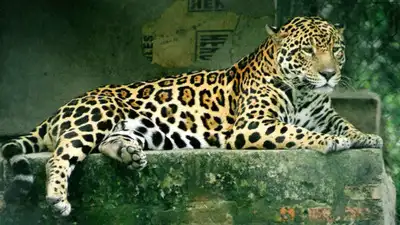
A jaguar (Panthera onca), in a wildlife rescue & rehabilitation centre in Formosa Province, Argentina. Image credits: Wikimedia Commons
The paper states that the establishment of the reserve in 2003 and its subsequent enlargements were observed, but that none of these factors can be shown to explain the change in survival estimates. Apparent survival, as reported in the 2015 PLOS ONE study, rose from 0.47 (±0.15) to 0.56 (±0.11) by 2012, a period that overlaps with the no-hunting ranch agreements adopted in 2007. The researchers stopped short of linking the rise to the reserve’s presence, since jaguars are long-lived with low reproduction rates, making short-term changes hard to attribute to any single cause; they also noted that 13 years of data were still not enough to reliably detect changes in density or survival. The purchased land at the core of the reserve, reported at roughly 20,000 hectares in the 2015 study, has grown since then to more than 56,000 acres (about 22,700 hectares), according to the Northern Jaguar Project’s own recent reporting. That figure covers purchased reserve land only; the separate 13,000 hectares of no-hunting ranch agreements are tracked apart from it and aren’t included in the acreage total.
What can be said is that neither the ranch agreements nor the sanctuary appear to have decreased survival rates. The project also operates Viviendo con Felinos, a program that pays ranchers in the region for documented camera-trap images of wild cats, according to the Northern Jaguar Project’s website. The reserve still hosts a small breeding population of jaguars today.
Warner Glenn, a rancher and hunting guide, was hunting mountain lions on March 7, 1996, in the Peloncillo Mountains on the Arizona, New Mexico border when his pack of hounds cornered a large cat that he later discovered was a jaguar. Glenn was an experienced hunter and before the jaguar was listed as endangered in the United States in 1997, there was no federal prohibition on taking the animal. Another study further analyzed the data over a period of 13 years. Published in PLOS ONE in 2015, the same lead researchers, along with Doherty, used the Barker robust design method, which combined closed sampling periods with resightings to estimate both apparent survival and abundance. They identified 467 jaguar photographs with 48 individuals and noted that digital cameras significantly increased the probability of detection in comparison to film cameras, with a mean density of 1.87 ± 0.47 jaguars per 100 km². Thirteen years of data showed 48 individuals
He photographed the animal, and his images are recognized as the first ever taken of a wild jaguar in the United States. This adult male jaguar was not intimidated and simply sat on the bluff, watching the hounds below. But instead, he decided to pull back his hounds and snap some photos of this magnificent animal. The photographs prompted biologists, including the Mexican zoologist Carlos López-González, to ask why a jaguar had appeared so far north when the species had not been seen alive in the wild in the United States for decades. The search for an origin population then took him into Sonora, Mexico, where he discovered a small, reproducing population of jaguars in the foothills of the Sierra Madre Occidental mountain range. Are Private Reserves Effective for Jaguar Conservation ?