
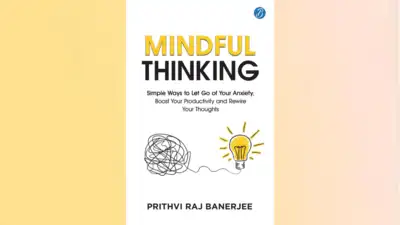
Book ‘Mindful Thinking’ explores how simple mental exercises can help manage stress and improve focus
Mental health conversations often begin with a problem: difficulty concentrating, mounting anxiety or the feeling of being unable to switch off after a demanding day. But addressing mental well-being need not start only when these challenges become difficult to manage. Building awareness of our thoughts, learning to direct our attention and recognising emotional responses can also be part of everyday life. The idea of mental fitness is to bring this preventive approach into focus, making the care of the mind a regular practice rather than an afterthought.
Founded in 2017, MindGym is a volunteer-led nonprofit that promotes mental fitness through practical, experiential exercises. Banerjee’s book, Mindful Thinking: Simple Ways to Let Go of Your Anxiety, Boost Your Productivity and Rewire Your Thoughts, introduces 12 MindGym techniques through an eight-week programme. Prithvi Raj Banerjee, founder of the MindGym Initiative, believes that simple mental exercises can help people develop these skills. Consider a student who sits down to study but keeps getting distracted, an employee who carries the tension of a difficult workday into the evening, or someone who reacts in frustration before having time to consider the situation. These are familiar moments in which attention and emotions shape our responses. Through MindGym, Banerjee encourages people to become more aware of such patterns and practise responding to them more deliberately. Its approach draws a parallel between physical and mental training: just as physical strength develops through regular exercise, attention and emotional self-regulation can be practised over time. Rather than asking people to make sweeping changes to their routines, the initiative focuses on exercises that can be incorporated into everyday life. These include Belly Breathing, Bumblebee Hum, Balanced Breath, Body Radar, Word Anchor, Catch and Drop, and Play and Pause. The exercises are designed to help participants practise directing attention, recognising emotional responses and disengaging from repetitive or unhelpful thought patterns. The approach is particularly relevant for children and young adults, who are navigating an environment shaped by digital distractions, constant information and competing demands on their attention. Learning to notice when the mind has wandered, recognise an emotional response or pause before reacting can be useful skills in classrooms, workplaces and everyday interactions. MindGym seeks to make this learning engaging through interactive workshops, games and biofeedback-based activities, including Mindball. The initiative reports having conducted hundreds of workshops since its inception, involving thousands of children and young adults from varied backgrounds. Observations made before and after sessions indicated improvements in participants’ ability to settle and sustain attention. These observations, however, are not clinical evidence that the programme treats mental health conditions. For Banerjee, the larger objective is to make mental fitness accessible to people beyond formal workshops. MindGym conducts sessions for children and adults, primarily online, while proceeds he receives from his book help support free workshops. By presenting mental exercises as practical activities rather than an abstract concept, the initiative aims to encourage people to engage more consciously with their own mental states. The emphasis on prevention is not a promise that stress can be eliminated or that mental health difficulties can always be avoided. Everyday exercises cannot replace professional care when it is needed. Instead, they offer a way to build awareness and practise healthier responses as part of daily life. In a world where attention is constantly in demand, learning to pause and recognise what is happening in the mind can be a useful starting point. The question is whether mental fitness can become as familiar a part of our routines as other habits we maintain for our well-being. Through the MindGym Initiative, Banerjee is encouraging people to begin that practice with simple exercises, one day at a time. You use AI every day. Now get your AI Quotient. Take the AIQ test Get the latest Lifestyle News and more. Download the TOI app.