
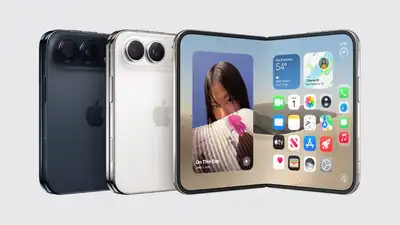
Apple iPhone Duo launched at Rs 2,99,900. The first foldable iPhone opens to a 7.6-inch screen and swaps Face ID for Touch ID.
Specification iPhone Duo Inner display 7.6-inch Super Retina XDR folding, nano-texture, ProMotion, Always On, 3,000 nits Outer display 5.4-inch Super Retina XDR, same aspect ratio, ProMotion, Always On Chip A20 Pro, 2nm, 6-core CPU, 7-core GPU, dual 16-core Neural Engine Rear camera 48MP Fusion Main with sensor-shift OIS, 48MP Fusion Ultra Wide, 2x optical-quality zoom Front camera 12MP Center Stage on outer display, under-display FaceTime camera inside Video 4K at up to 120 fps in Dolby Vision, 4K time-lapse, Photographic Styles 3 Battery Dual battery, 31 hours video on inner display, 44 hours on outer, 24 hours typical use Charging 50 per cent in about 20 minutes wired, about 30 minutes on MagSafe Security Touch ID in the side button, no Face ID Build Grade 5 titanium frame and hinge cover, Ceramic Shield 2 front, IP68 Connectivity eSIM only, C2 modem, N1 chip with Wi-Fi 7, Bluetooth 6 and Thread Software iOS 27.1 with Split View, StandBy, Siri AI in beta, Apple Pencil support later this year Storage 256GB, 512GB, 1TB, 2TB Colours Star white, night sky Price in India From Rs 2,99,900
iPhone Duo price in India and availability: Price starts at Rs 2,99,900 and pre-orders open on October 16
Apple has launched the iPhone Duo, its first foldable phone, at Rs 2,99,900 in India, arriving roughly seven years after folding phones went on sale elsewhere. It comes in star white and night sky, with pre-orders from October 16 and sales from October 23, a month after the iPhone 18 Pro. The 5.4-inch outer Super Retina XDR screen carries more than 90 per cent of the screen area of an iPhone 18 Pro. Open it and there is a 7.6-inch inner display, half again as large as the iPhone 18 Pro Max and the biggest Apple has put on an iPhone. Both screens share an aspect ratio, so content scales across them cleanly, and both run ProMotion and Always On at up to 3,000 nits. Trade-in credit ranges from Rs 4,500 to Rs 81,500 depending on what you hand over, there is No Cost EMI of up to six months, and instant cashback of up to Rs 7,000 on American Express, Axis Bank and ICICI Bank cards. The iPhone 18 Pro begins at Rs 1,64,900 and the iPhone 18 Pro Max above it, which puts the Duo at close to twice the cost of a Pro for a phone that carries the same chip and a smaller camera system.
Apple is calling it the most transformational change to the iPhone since the original, and it does break with a fair bit of iPhone convention: Face ID is gone, replaced by Touch ID in the side button, and there is no SIM tray or Action button either. Shut, the Duo works like a normal phone. The inner panel gets a nano-texture finish that cuts glare and, more usefully, makes the crease harder to see. Apple is running the usual launch offers alongside. It is worth holding that starting price against the rest of the range. What the money buys is the folding screen and the software built for it, not better photography. AppleCare+ is offered as usual, and given that this is a first-generation folding device with a hinge that has to survive years of opening and closing, it is a more relevant question here than on a regular iPhone.
Under the cover layer is a custom polymer the company says is up to 40 per cent stiffer than the industry norm, with high-strength glass above and below the folding panel and adhesives that let the layers slide against each other like pages, so the screen does not absorb the bend stress. The frame and hinge cover are grade 5 titanium, the front carries Ceramic Shield 2 with three times the scratch resistance of the last generation, and the phone is rated IP68. Inside is the same A20 Pro as the iPhone 18 Pro, built on a 2nm process, with a 6-core CPU that is 20 per cent quicker than the A19 Pro, a 7-core GPU up 40 per cent, a dual 16-core Neural Engine and 50 per cent more memory bandwidth. Apple claims up to 35 per cent better sustained performance than the iPhone 17 Pro, helped by a vapour chamber bonded to the chip package. A battery sits on each side and the two behave as one, giving 31 hours of video on the inner display, 44 hours on the outer, and 24 hours of typical use when both get equal work. Charging reaches 50 per cent in about 20 minutes over cable, or around 30 minutes on MagSafe. The N1 chip handles Wi-Fi 7, Bluetooth 6 and Thread, and Apple’s own C2 modem does cellular.
The inner display is built from ten ultra-thin layers with wide-angle OLEDs, and the FaceTime camera sits under the panel so nothing interrupts the surface. Durability is where Apple has done its longest engineering pitch. A titanium plate runs along the base. The hinge alone uses more than a hundred parts. A new display engine drives both screens at once.
Pingback: How Apple iPhone Duo got Samsung and Google in an 'ugly fight': The wider industry impact
Pingback: How display of iPhone Duo, Apple's first foldable phone, is: The wider industry impact