
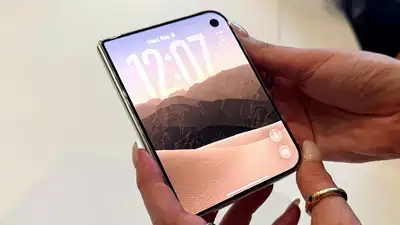
How display of iPhone Duo, Apple’s first foldable phone, is different from that of Samsung Galaxy Z Fold 8
Apple is finally jumping into the foldable phone game with the iPhone Duo, nearly 8 years after Samsung first brought folding smartphones to the world. To achieve this, Apple says it has developed a custom polymer specifically for the nano-textured cover layer, which the company claims is 40% stiffer than materials typically used elsewhere. The inner foldable display itself is built using 10 ultrathin layers, also finished with the same custom nano-texture coating to reduce glare across the entire panel.
When the South Korean behemoth launched its foldable lineup for the first time, the category felt more like an experiment than a mainstream product.
Beneath the surface, Apple relies on custom viscoelastic adhesives to hold the display’s various layers together, an engineering choice aimed at improving flexibility and longevity as the phone folds and unfolds repeatedly over time, according to Macrumors. The gap tells you a lot about how Apple has been careful in its approach to this format, choosing to wait and see. Foldables, in contrast, have matured over the years. The early foldables had visible fold lines, fragile screens and design compromises that made them feel more like a proof of concept than something built for real life. Over successive generations, Samsung steadily refined the formula, improving hinge mechanisms, reducing crease visibility and strengthening the display itself against daily wear and tear. Both the iPhone Duo and Samsung Galaxy Z Fold8 use OLED display technology across their inner and outer screens – a now-standard choice for foldables. Samsung’s Galaxy Z Fold lineup has grown steadily over the years, with each generation typically bringing a marginally larger inner display alongside a wider, more usable outer cover screen. Apple’s iPhone Duo enters this same broad size category, aiming to offer a spacious inner display for multitasking and content viewing Apple has taken a distinctive approach with the iPhone Duo’s display, built around what the company calls a nano-texture finish. This gives the screen a matte look that cuts down on glare and reflections, while also helping visually minimise the crease that naturally forms along a foldable’s hinge area. This layer is further reinforced with a scratch-resistant coating, adding another layer of durability to the display’s outer surface. Apple has also managed to hide the under-display FaceTime camera within the inner screen, allowing the display to remain visually uninterrupted without a visible camera cutout.