
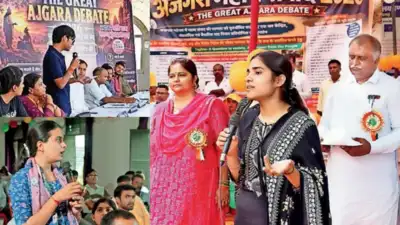
Participants tackled ethical questions at Great Ajgara Debate
More than 1,500 debates were held across 17 development blocks, 19 municipalities and four administrative zones. The initiative is called ‘The Great Ajgara Debate 2026’, and at its heart is an ambitious search: the search for a modern-day Yudhishthir – a contemporary citizen capable of confronting difficult moral dilemmas with reason, wisdom, ethical judgment and courage. The scale of ‘The Great Ajgara Debate’ is astonishing as the debate has spread across 1,148 gram panchayats and 279 urban wards, covering 17 development blocks, 19 municipalities and four zones. More than 1,500 debates were planned throughout the district. By Aug 26, the district had identified 1,427 debaters, representing every panchayat and ward.
Because a great dialogue happened there,” says the Pratapgarh DM, it is revered.
“What makes Ajgara special is not a miracle or a fair, but a great dialogue that took place here,” Pandey said. Local contests in gram panchayats and urban wards produced representatives, cutting a field of 1,427 participants down to eight finalists, collectively called the “Ajgara 8”. “If we continue to celebrate Diwali by lighting lamps the way Ayodhya welcomed Lord Ram, and we continue to celebrate Raksha Bandhan through the traditional tying of the ‘raksha sutra’, why can’t we carry forward this legacy as well,” asks Pandey. Pandey says the inspiration for the initiative emerged from a growing realization within governance that meaningful engagement with young people is essential. He says the state govt was increasingly feeling the need to understand the aspirations, anxieties and expectations of Gen Z. “We needed better communication with the youth,” he explains. From an administrative point of view, this helps us understand how society’s values, morals and priorities have evolved over time,” he says. “By listening to how citizens think through ethical dilemmas and public issues, administrators gain deeper insight into social attitudes and changing perceptions,” Pandey says.
“If we continue to celebrate other traditions, why not preserve this legacy of debate and questioning? What started as a district initiative soon became a grassroots marathon. The great Ajgara debate: ‘Yakshh Samvad’ inspires an epic public discourse What would you do if telling the truth destroyed an innocent life, but a lie could save it? Can a decision be perfectly legal and yet morally wrong? Should compassion prevail over truth? Does justice lie in intent or outcome? And when technology increasingly shapes human choices, are people still truly free? These are not questions from a philosophy classroom, a university seminar, or a television debate. They are being asked in village squares, panchayat meetings, town halls and community gatherings across Pratapgarh district of Uttar Pradesh, where an extraordinary experiment is unfolding. “What gives Ajgara reverence is not that some miracle happened there, or that it hosted some grand fair. That observation became the foundation of a bigger idea. “This is a legacy of debating. If Ajgara is to be celebrated in its true essence, then debate must return,” he remarks. Pandey felt traditional formats were insufficient. Instead of speaking to youth, the administration wanted youth to speak, and debate format offered exactly that opportunity. “We wanted to invite people to talk, debate and argue. He adds that such an exercise helps create a governance model that is proactive rather than reactive. What began as an experiment quickly evolved into a mass movement. All gram panchayat and wards were instructed to convene a general body meeting, much like a regular local governance gathering. Participants selected their own debate formats, discussed questions and chose representatives.
More than 1 lakh people in Pratapgarh have been wrestling with questions on ethics, morality and the future, turning 1,148 gram panchayats and 279 urban wards into debating rooms in what may be one of India’s largest public exercises in ethical discourse. Some participants were aged over 70. Ajgara’s association with dialogue stretches back more than two millennia,” he claims, adding that even by conservative estimates, the Yaksh-Yudhishthir dialogue dates back around 2,200-2,500 years.
Because the questions being discussed are fundamentally human rather than academic, the competition was deliberately designed this way. As a result, young students debated alongside elderly citizens. Because the questions had no definitive answers, many believed passionately in their reasoning.
That emotional investment revealed something deeper. The administration is ensuring that the discussions are not lost once the event concludes.
The pond at Ajgara witnessed the legendary dialogue between Yaksh and Yudhishthir, according to the epic. Instead, participants were grappling with the same kinds of philosophical dilemmas that have challenged humanity for centuries,” he says. They are similar to questions asked by the Yaksh,” says Pandey, adding that for this wisdom and logic matter more than degrees. “If Oxford can establish itself as a centre of international debating in 300-400 years, why can’t we,” he asks.
LUCKNOW: Yudhishthir stood before a Yaksh and answered questions on truth, duty and justice. That question-and-answer session from the Mahabharata has found a modern sequel in Pratapgarh. Farmers argued with students. Homemakers took on professionals. Senior citizens joined teenagers. Long before parliaments, television studios and social media timelines became arenas of public discourse, Indian civilisation celebrated ‘samvad’ (debate) as a path to wisdom. In Mahabharat, it was through a searching dialogue between Yaksh and Yudhishthir at Ajgara that profound questions of truth, duty, justice and human conduct were explored. More than two millennia later, that ancient tradition of questioning and reasoning is being revived in an unlikely setting: the villages and towns of Pratapgarh district. A legendary episode has been transformed into a major exercise in democratic conversation, inviting over a lakh citizens to engage in a modern-day ‘samvad’ on morality, ethics and the dilemmas shaping contemporary life. The story begins at Ajgara, a village in Pratapgarh associated with a powerful episode from the Mahabharata. In that encounter, Yudhishthir was subjected to profound questions about life, truth, duty, justice and human nature. His answers, rooted in wisdom and moral clarity, allowed him to prevail. One of the most unusual features of the debate is that participation is open to everyone. Age, educational qualifications and professional background are irrelevant. “We were not asking factual questions. These questions did not require domain knowledge. “These questions are metaphysical in nature. One of the strongest signals that the initiative had struck a chord came when participants who failed to advance began writing to the administration, arguing that they deserved another opportunity. The questions in the debate had no universally accepted answers. Participants did not compete to find the correct response but to demonstrate balanced reasoning, ethical reflection and intellectual honesty. Pandey speaks about his ambition of turning Ajgara into a global centre for debate, a heritage site and a potential intellectual destination. The comparison may sound audacious, but Pandey sees a historical foundation for it. “Oxford’s debating traditions span a few centuries. Every debate is being documented.
Great Ajgara Debate 2026, launched by Pratapgarh district magistrate Abhishek Pandey, will culminate on Sept 17, when eight finalists face off at Ajgara — associated with the Yaksh-Yudhishthir samvad. Those participants then advanced through successive stages until the field narrowed to 36, then 16 and then eight finalists, known as the Ajgara 8, who will compete at the grand finale on Sept 17 at Ajgara. The winning question receives a prize of Rs 1 lakh. On Sept 17, the journey will reach its symbolic climax. The ultimate prize may not be the Rs 1.51 lakh awaiting the winner.
You Can Also Check: Gold Rate in Lucknow | Silver Rate in Lucknow | Bank Holidays in Lucknow | Public Holidays in Lucknow | Lucknow AQI | Weather in Lucknow | Petrol Price in Lucknow | Diesel Price in Lucknow | CNG Price in Lucknow | LPG Price in Lucknow Stay updated with the latest Lucknow news.
It was the number of people who turned up to listen,” he says. More than 1,500 debates are being recorded, creating what Pandey hopes will become an “annual intellectual archive”. Such communities become better partners in governance,” he says. Meaningful communication requires citizens who can evaluate, question and contribute, according to Pandey. The greater achievement could be the revival of a culture that values thoughtful disagreement, intellectual humility and ethical reasoning,” Pandey says.
Pandey, an IIT Roorkee graduate, Oxford fellow and former debater, wanted to bring that ancient tradition of samvad into a modern democratic setting. More than one lakh people have taken part in the debate. Yet for Pandey, the most remarkable statistic is not the number of speakers. “The most fascinating part for me was not the number of people who turned up to debate. The proposed Ajgara archive will preserve questions, arguments, perspectives and insights generated through the movement. Each year, organizers also plan to identify a ‘Question of the Year’, capturing the issue that most profoundly reflects the concerns of society. Perhaps the most innovative aspect of the initiative lies online. Through the platform ‘Ajgara Debate’, people may participate in the section called ‘Aaj Ka Yaksh’. Hundreds of entries have already poured in. The strongest questions are selected and showcased. This creates a fascinating dual search. The debate seeks the modern-day Yudhishthir, the one capable of answering. ‘Aaj Ka Yaksh’ seeks the modern-day ‘Yaksh’, the one capable of asking the question worth answering. One of the recurring complaints in local administration is that citizens often remain passive until problems become severe. “Citizens capable of reasoning critically can engage effectively with public policy, identify local problems and hold institutions accountable. The eight finalists will gather at Ajgara, beside the pond associated with one of India’s most celebrated dialogues. Centuries after Yudhishthir answered the Yaksha’s questions, another set of citizens will confront questions about truth, ethics, justice and humanity. “Think, question, debate and only then answer. Nor may it be the title of Pratapgarh’s modern-day Yudhishthir. Download the TOI App.