
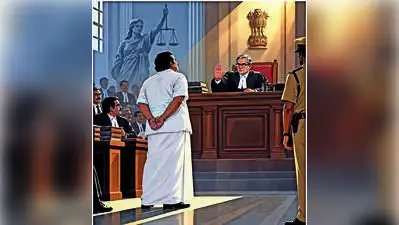
High office does not confer immunity from judicial process, but legitimate practical difficulties may justify judicial accommodation
On Aug 28, a Madras high court judge asked counsel for Tamil Nadu finance minister N Marie Wilson a question: “Are you the King of England? Article 14 guarantees equality before law. Article 361, for instance, protects the President and governors from criminal proceedings during their term of office and imposes special conditions concerning certain civil proceedings. In K Veeraswami vs Union of India (1991), Supreme Court recognised procedural safeguards concerning criminal proceedings against serving judges. The reference sometimes made to Section 133 of the Code of Civil Procedure is of limited relevance. Sections 205 and 317 of the old Code of Criminal Procedure enabled a magistrate, in appropriate circumstances, to permit an accused to appear through counsel. Bharatiya Nagarik Suraksha Sanhita, 2023, continues the principle in Section 228. In Maneka Sanjay Gandhi vs Rani Jethmalani (1979), the Court recognised the need for a liberal and pragmatic approach where circumstances warrant exemption.
Because of his position, he pointed out that even former Prime Minister P V Narasimha Rao had appeared before a court while holding office, and questioned why a serving minister should expect different treatment merely. Because he holds ministerial office, he enjoys no personal immunity from criminal proceedings merely. The minister was facing criminal proceedings before a Judicial Magistrate in Puducherry. His counsel sought exemption from personal appearance, citing ministerial responsibilities and the assembly session. The judge was unimpressed. Then came the line: “Are you the King of England? Instead of making the ‘king of England’ statement, the judge could have expressed the point in simpler language: “You are not above the law. It described a constitutional and legal position in which the Crown occupied a distinct status and enjoyed immunities that ordinary subjects did not. A minister in India occupies no such position. He is a constitutional functionary, not a sovereign. He exercises public power under a written Constitution, and that power is subject to constitutional and judicial limits. That, in essence, is what the judge’s question conveyed: what is it about holding ministerial office that places you beyond the ordinary operation of the law? Independent India did not merely inherit the constitutional order of the British Crown. It replaced it. The Constitution does recognise specific immunities for certain high constitutional offices. That is a constitutional immunity expressly created by the Constitution. No equivalent provision exists for ministers, nor should the position of ministers be confused with the institutional safeguards surrounding serving judges of Supreme Court and high courts. Judicial protocol also ordinarily protects judges from being unnecessarily required to appear personally in other courts. These safeguards serve an institutional purpose: protecting judicial independence and the functioning of the judiciary. They do not confer sovereign status. A minister has neither the constitutional immunity of the President or governor nor the institutional protection afforded to the judiciary. That provision concerns personal appearance in civil proceedings. It cannot be invoked as a general exemption from personal appearance in a criminal case. None of this means that an accused must invariably appear personally before a criminal court. The law has always recognised circumstances in which personal attendance may appropriately be dispensed with. The magistrate may excuse personal attendance for sufficient reason and may subsequently require the accused to appear personally. Supreme Court has repeatedly emphasised that such discretion must be exercised sensibly and in appropriate cases. The principle is not that personal attendance is invariably mandatory; nor is it that exemption follows automatically from social or political status. The crucial distinction is between immunity from the process and exemption from personal attendance. The former is a matter of constitutional or statutory law. The latter is a matter of judicial discretion.
Historically, the Crown stood apart from the ordinary conception of the defendant before the law.