For Delhi-NCR, which is annually in the news for its winter air pollution crisis, the Gujarat experience also offers a useful model
NEW DELHI: Nearly 15 years ago, a handful of economists, engineers and regulators began wrestling with a question in Gujarat. Today, that experiment has an answer in the emissions trading scheme (ETS), which is travelling nearly 14,000 km from India, poised to become one of the country’s newest environmental exports. The Brazilian city has signed a letter of intent to examine adapting this approach to its own pollution challenges.
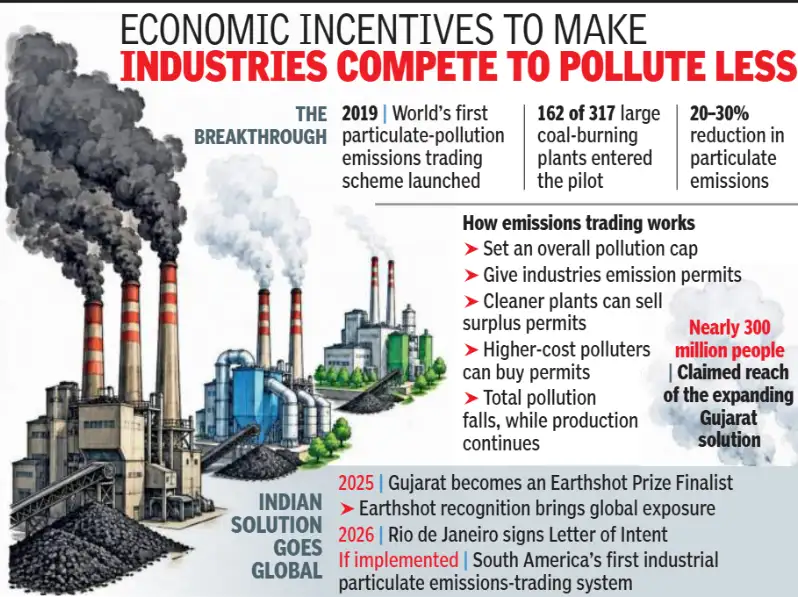
Could factories be persuaded to cut pollution without fearing a shutdown? After transforming industrial pollution regulations in Gujarat and inspiring similar programmes in Maharashtra and Rajasthan, the idea that germinated in India is headed to Rio de Janeiro. If implemented, Rio would become South America’s first emissions trading system for industrial particulate pollution. For Delhi-NCR, which is annually in the news for its winter air pollution crisis, the Gujarat experience also offers a useful model, which is centred around incentives that make industries compete to pollute less, rather than punishing them when they pollute more. For decades, India’s industrial pollution control has relied largely on periodic inspections and shutdown notices when factories breached emission limits. Researchers believed there was a better way — one that rewarded environmentally cleaner factories, instead of treating every factory in the same way. The idea is simple. Regulators set a maximum pollution limit for an industrial cluster and divide it into permits. Factories that cut emissions beyond their target can sell surplus permits to plants finding it harder or costlier to clean up. Cleaner factories can earn, while others get flexibility to comply. At the same time, the pollution stays within the overall cap.
The approach was piloted in Surat in 2019 by researchers affiliated with the Energy Policy Institute at the University of Chicago (EPIC) and J-PAL, which was working with Gujarat Pollution Control Board (GPCB). The pilot covered 162 of Gujarat’s 317 large coal-burning industrial plants, while the rest remained under conventional regulation, allowing researchers to compare the two approaches. In the randomised trial, the participating plants cut particulate emissions by 20-30% and pollution-control costs by 11%. Compliance touched 99%, against roughly two-thirds under the conventional system. Researchers estimated the benefits exceeded costs by at least 25 times. Indian solution goes global Conventionally, a typical plant emitted around 1,300 kg of particulate matter a month. Emissions from similar industries operating under the ETS fell to roughly 900-1,000 kg a month — a 20-30% reduction that held across all 10 compliance periods during the nearly two-year study from April 2019 to 2021. Today, the programme covers a population of nearly 300 million across the country and is expanding to sulphur dioxide and wastew-ater pollution. Dr Bala Srinivasan, the EMA co-chair, said the international journey accelerated after Gujarat became an Earthshot Prize Finalist in 2025.
You Can Also Check: Gold Rate in Delhi | Silver Rate in Delhi | Bank Holidays in Delhi | Public Holidays in Delhi | Delhi AQI | Weather in Delhi | Petrol Price in Delhi | Diesel Price in Delhi | CNG Price in Delhi | LPG Price in Delhi Stay updated with the latest Delhi news.
Just as pollution doesn’t respect borders, ideas don’t respect borders too,” said Emissions Market Accelerator (EMA) co-chair Michael Greenstone, one of the four researchers who worked with GPCB on the experiment. But we created the scheme such that there were no losers,” Deb told TOI . Only one industrial closure occurred under the system in seven years, he said. “Earthshot suddenly gave us a lot of global exposure,” Srinivasan said. That visibility, he said, helped open conversations beyond India — including Rio — and generated fresh interest among Indian states as the prize prepares to come to Mumbai later this year.
The flexibility built into the system allowed firms to meet their pollution commitments more efficiently and at a lower cost. “This pollution market was made in India, tested in India and it succeeded in India. For Dr Kaushik Deb, the executive director of EMA, the challenge lay in convincing industrial units that cleaner air need not come at the expense of growth. “The first reaction was, ‘why another form of regulation? Founded by Prince William, the prize identifies and helps scale breakthrough environmental solutions from thousands of entries worldwide. For Delhi-NCR, the Gujarat experiment offers a different way of thinking about industrial pollution, and gives industries an economic reason to reduce emissions, rather than relying only on inspections, penalties and shutdowns. and the Gujarat model cannot simply be transplanted, the experts suggest that less emission across sectors can become a competitive advantage rather than merely a regulatory burden While the pollution problem of the national capital region is far more complex than Surat’s industrial cluster. In a region where repeated restrictions have often produced friction between pollution control and economic activity, that may be a lesson worth examining. Download the TOI App.