
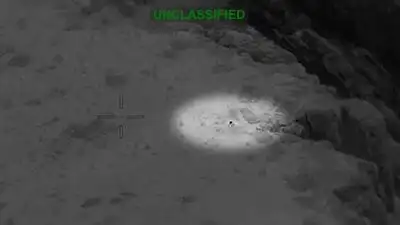
Declassified video of the rescue
NEW DELHI: A newly declassified video has revealed details of a high-risk US military operation to rescue an Air Force officer who spent nearly 50 hours wounded and hiding behind enemy lines in Iran after his F-15E fighter jet was shot down in April. More than 90 US service members were deployed on the ground during the rescue operation, while hundreds of personnel were involved in the air and several thousand others provided support, according to CBS News’ ’60 Minutes’. Bravo was the weapons-systems officer aboard the two-seat F-15E, operating under the mission callsign Dude 44. The aircraft was hit by an Iranian shoulder-fired missile during a strike mission near Isfahan on April 2. The missile damaged Bravo’s parachute and he fell at an estimated 70 to 100 mph before hitting the ground in a mountainous desert region. Bravo, despite his injuries, moved away from his landing site and climbed towards a 7,000-foot ridgeline, where he found a position from which he could remain concealed. The rescue force included more than 90 US service members on the ground, marking the first deployment of US troops on Iranian soil in 46 years, according to Adm. More than 90 elite US service members were left stranded on the ground until a clandestine Air Force unit arrived to assist them. The US military ultimately destroyed the two stranded aircraft, each worth about $100 million, along with the Little Bird helicopters to prevent sensitive technology from falling into Iranian hands.
The operation involved combat search-and-rescue teams, CIA intelligence and deception efforts, helicopters, bombers and drones, as US forces raced against time to locate and extract the officer, identified by his callsign “Bravo”. He suffered a broken back, arm and shoulder and landed around five miles from his pilot, “Alpha”. “At one point when I looked up and saw no parachute, that was the most terrifying thing I’ve ever seen,” Bravo said in his first public account of the incident. “It was a gun fight all the way in and all the way out,” US Defense Secretary Pete Hegseth said. “Never let a lack of motivation put you on Iranian TV,” Bravo said. Dan Caine, chairman of the Joint Chiefs of Staff, said Iranian ground forces came within a few hundred metres of Bravo. “There was clear intent out of the Iranian ground force to come find those two guys,” Caine said. “That was a really tough decision,” Hegseth said. “I’ll never forget, you know, being in the situation room and saying, ‘OK, I guess we’re gonna roll 24,’ which means, ‘Hey, Bravo’s going to be out there for basically 24 hours more.'” CIA deception, air strikes clear rescue path Bravo survived another full day in the cold and windy high-desert terrain with almost no food or water. “I think what you need to know is we would have sent more to go get the back-seater,” Caine said, referring to Bravo’s position in the fighter jet. Small “Little Bird” helicopters were then used to reach Bravo on the distant ridgeline. He described the moment as “one of the greatest moments of my life”. When his rescuers reached him, Bravo said, he had only one thing to say: “Let’s go. Reflecting on the mission, Bravo said the operation represented more than his own survival.
“So I paused, right then, and I prayed, ‘Lord, your will be done. But if I’m getting through this, I need help.'” Alpha ejected safely and was rescued during a risky daytime operation about six hours after the aircraft was shot down. US helicopters involved in the mission came under fire as they entered and exited the area. “But they got Alpha back. However, the rescue team could not locate Bravo and had to withdraw, leaving the injured officer alone behind enemy lines. As Iranian forces searched for the downed crew, US officials tracked their movements. Gen. Bravo eventually managed to contact US forces and informed them that he was injured but still moving. However, a planned rescue could not immediately be carried out. The CIA played a key role in the search, using intelligence capabilities and a multi-pronged deception campaign to confuse Iranian forces trying to locate him. The agency also used technology to pinpoint his position. US bombers and drones then struck Iranian Revolutionary Guard forces in the area where Bravo was hiding, helping clear the way for the second rescue attempt. Brad Cooper, the US Central Command commander. Several hundred personnel were involved in the air operation, while thousands more supported the mission from elsewhere. ‘Let’s go’: Final extraction The rescue force arrived aboard two large search-and-rescue aircraft, which landed on a makeshift desert airstrip. After spending nearly two days wounded and isolated behind enemy lines, Bravo finally saw the rescuers approaching. The mission, however, was not yet over. The rescue aircraft became stuck in the desert sand and their landing gear could not be freed. Fifty hours after being shot down, Bravo was finally brought to safety as the sun rose on Easter Sunday. “It’s a story of the teamwork, the training, of the faith, of the decisions and the leadership to do something that will live in history as an example of what America’s willing to do, in order to uphold our promise and leave no man behind. Catch the latest World News and Live updates. Download the TOI app.