
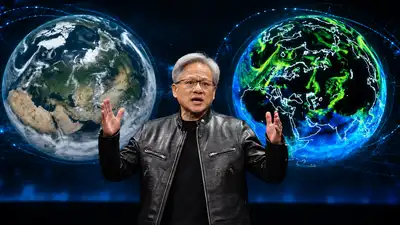
Nvidia, founded and led by Jensen Huang, is developing Earth-2, an AI-powered platform designed to simulate and visualise weather and climate conditions at increasingly high resolution. The project combines artificial intelligence, GPU computing, physical simulations and geospatial visualisation to create a digital twin of the planet. Its models can generate global forecasts, downscale atmospheric information to much finer scales and simulate the development of hazardous weather. The technology is moving beyond conventional forecasting into applications such as flood-risk assessment, storm modelling and climate resilience planning. Nvidia’s work with weather agencies, climate researchers and risk-modelling companies has already produced simulations covering hundreds of years of hypothetical atmospheric conditions, showing how AI-generated scenarios could help cities and infrastructure planners examine extreme events that are poorly represented in historical records.
The company formally announced its Earth-2 climate digital-twin cloud platform in 2024, describing it as a system for simulating and visualising weather and climate from the global atmosphere down to local phenomena such as cloud cover, typhoons and turbulence. Nvidia’s Earth-2 research programme covers several parts of the Earth-system modelling process, including atmospheric-state estimation, generative data assimilation, high-resolution weather simulation and hybrid physics-AI modelling. One of Earth-2’s most important functions is downscaling. The current Earth-2 platform says CorrDiff can perform this process up to 500 times faster, with Nvidia reporting a 10,000-fold improvement in energy efficiency for its current comparison. The earlier version announced in 2024 was reported as producing 12.5-times higher-resolution outputs than the numerical model used in the comparison, while operating 1,000 times faster and 3,000 times more energy efficiently. The broader Earth-2 model family announced by Nvidia in 2026 represents a further shift towards an end-to-end AI weather system.
Its present architecture brings together AI models, GPU-accelerated physical simulations, observational data and visualisation tools rather than relying on a single forecasting model. The platform also incorporates simulations from established systems including ICON, WRF and PALM and can combine them with geospatial data for city-scale visualisation. Global weather models divide the atmosphere into relatively large grid cells, while decisions made by cities, utilities and emergency agencies often require information at much smaller scales. Nvidia’s CorrDiff model uses generative AI to create higher-resolution weather information from lower-resolution inputs. Nvidia describes it as an open collection of models, libraries and frameworks covering observational data processing, atmospheric initialisation, global forecasting, local nowcasting, high-resolution downscaling and visualisation. The company’s stated objective is to make these capabilities available to researchers, governments and developers who can run and adapt the models on their own infrastructure.
The ability to generate large ensembles is particularly significant for climate-risk planning. Historical observations provide only a limited sample of rare disasters, whereas synthetic scenarios can explore combinations of atmospheric conditions that have not occurred within the available record. The Elbe project illustrates this approach by generating hundreds of years of hypothetical atmospheric conditions and feeding them into flood models. Such datasets can help insurers, infrastructure operators and governments investigate tail risks, estimate the consequences of extreme events and assess how resilience measures perform across different scenarios.