
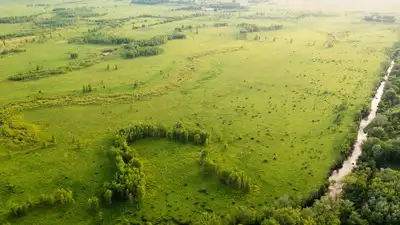
The nearly 2,000-acre property will become part of the Avon Bottoms Wildlife Area.
A Wisconsin family spent years trying to make nearly 2,000 low-lying acres along the Sugar River work as farmland. The land stretches along more than two miles of the Sugar River in Rock County, about 45 minutes south of Madison. They now have nearly 2,000 more acres to do that. With this acquisition, the total protected area across four linked Avon Bottoms projects has reached about 2,600 acres.
Because large opportunities to protect land of this size are uncommon in southern Wisconsin, the conservation groups said the property is especially significant. The former Applegate-Bader Farm is now permanently protected after Groundswell Conservancy and Ducks Unlimited completed the purchase of the property, The Good Press reported.
“Protecting nearly 2,000 acres at once creates an even larger, connected corridor where wildlife of all kinds can move, feed, nest and thrive,” said Amy Mertz, Groundswell Conservancy’s director of development and communications, as quoted by The Good Press. It also supports threatened Cerulean Warblers and Acadian Flycatchers, as well as protected Blanding’s Turtles, according to wildlife biologist Jason Cotter, who spoke to The Daily Cardinal. Tony Abate, senior director of conservation at Groundswell Conservancy, said the property gives people more space for outdoor activities. “This project creates new access to the lower Sugar River on the south side,” Abate said. Abate said the land could have had a different future without the conservation purchase. He said it might have been subdivided and sold to people seeking private recreation, which would have kept the land in private hands and limited public access to the southern part of the lower Sugar River. “We hope to maximize wildlife habitat potential on the property through wetland enhancements and upland management,” said Brian Glenzinski, Ducks Unlimited’s director of conservation programmes for the Upper Midwest. He said one part of the plan will involve controlling woody growth that has spread across the property.
But the property’s location in a floodplain made farming difficult, and the drainage system could not keep pace with the water. It includes wetlands, floodplain forests, prairies and river frontage. The property provides habitat for several species, including endangered Yellow-crowned Night-Herons and Ornate Box Turtles. The wetlands also have a role beyond providing habitat. They filter nutrients, store floodwater and recharge aquifers. The property is already open to the public for hiking, fishing, hunting and wildlife watching. It also provides new access to the lower Sugar River on its south side. “There’s tremendous opportunity for outdoor recreation, so people who love to get outside and hike, birdwatch, hunting, fishing, trapping, cross-country skiing, those kinds of activities. Ducks Unlimited plans to manage the property to improve its wildlife habitat. The organisation expects to carry out wetland enhancements and upland management. Prescribed fire will be used to remove some of that growth and improve nesting habitat for waterfowl and other grassland birds. The land is part of a wider conservation effort around the Avon Bottoms. Catch the latest World News and Live updates. Download the TOI app.
The purchase is the largest land protection project in Groundswell Conservancy’s 43-year history.
In 2016, Applegate-Bader sued Wisconsin’s Department of Revenue after a rule change excluded permanent conservation easements from the state’s “use-value” farmland tax assessment. The conservation deal came after years of difficulty for the family. It is also Ducks Unlimited’s largest acquisition in Wisconsin. The organisations plan to transfer ownership of the property to the Wisconsin Department of Natural Resources, keeping the land protected and open to the public.
The dispute went through the courts before the family eventually found a conservation buyer for the property.
The nearly 2,000-acre property will become part of the Avon Bottoms Wildlife Area. The area is already recognised as a state Conservation Opportunity Area and an Important Bird Area. The newly protected land connects wetlands, prairie and forest into one continuous wildlife corridor.