
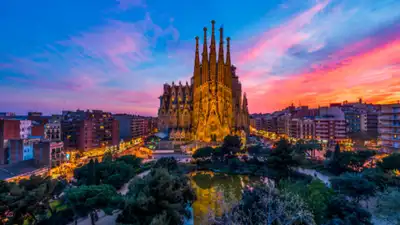
A Spanish glue company’s bonds played an essential role in the binding of stone and steel for the Sagrada Familia temple’s 826 panels. The world’s tallest church, which was blessed by Pope Leo XVI last week, had been a century in the making. Its architect Antoni Gaudi knew exactly what the six central towers should look like, but what he did not know was that technology would play a pivotal role in the realisation of his dreams.
The first stone for the construction was laid in 1882 under the direction of Francisco de Paula del Villar. Gaudí died in 1926, leaving only partial models and conceptual designs for the unfinished basilica, meaning subsequent architects had to interpret his complex geometric intentions. Specifically, Loctite EA 9497 from Henkel, the element that has made it possible for stone and steel to behave as a single material. The towers have been built using a modular system of prestressed stone panels, 826 in total, incorporating more than 2,100 stone elements joined to metal structures, according to a report by Euronews. Each panel required around 30 kilos of adhesive. In all, 24 tonnes were applied in liquid form, able to fill every cavity and secure the joint before a curing process of around 24 hours began. The bond withstands loads equivalent to 100,000 people per square metre or the weight of 1,600 African elephants. At 172.5 metres, the Sagrada Familia is now the tallest religious temple in the world, ahead of Ulm Minster in Germany. For years, 2026 was cited as the symbolic completion date, coinciding with the 100th anniversary of Gaudí’s death.
Because the surroundings matter, the glue matters. However, in the final stage of his life, while working on the Nativity Façade, he introduced innovative materials for the time, including concrete in the upper sections, and utilised prefabricated elements.
In many cases, they’ve brought to life ideas that Gaudí had already envisioned or begun,” said David Puig, Assistant Architect. “This project highlights how innovation and collaboration continue to drive progress,” said Adrián Orbea, president of Henkel Ibérica. This is complemented by collaborations with external companies,” said Puig.
Located in the heart of Barcelona, the monument is one of the architect’s many masterpieces. His unique interpretation of Christianity, nature, geometry and the world produced a complex design that is innovative to date. A year later, it was reinterpreted by Gaudí to become a Barcelona landmark and a UNESCO World Heritage Site. Gaudí began the Sagrada Família with the crypt and the apse wall, employing traditional methods: small stones and manual adjustments by stonemasons. Initially, Gaudí used sandstone from Barcelona’s Montjuïc mountain. Highly prized by architects, this sedimentary rock stands out for its superior strength compared to other varieties and for its wide range of colours: light grey, greenish grey, beige, yellow, ochre, gold, purple and reddish tones. However, when construction of the Passion Façade began, the shortage of Montjuïc stone became evident. Shortly afterwards, quarrying was abruptly and permanently halted. What Gaudí had planned by hand was ultimately completed by machines. “Technologies have revolutionised our processes. One of the hallmarks of his method is that the interior geometries evoke shapes found in nature: straight lines are arranged to create the illusion of undulating columns and walls. “To carry out such a complex geometric project, two-dimensional plans weren’t enough for Gaudí; he needed to work in three dimensions using plaster models. Since the same array of colours could not be found in present-day Barcelona, stones from Germany, France and UK were delivered for construction through an international logistics network. The scale of the project, limited space on the site, increasingly occupied by the construction itself, and the constant flow of visitors led the Construction Board to implement its own logistical system. The solution was to move much of the work off-site: elements are prefabricated in external workshops and only transported to the basilica for final assembly. This was the case, for example, with singular pieces like the star atop the Virgin Mary Tower and the cross that will crown the Jesus Christ Tower; these works were crafted in specialised facilities before being transported and assembled in Barcelona. But what still remains one of the most interesting parts about the project is its use of glue. A figure that explains why the Tower of Jesus Christ, the tallest in the complex, can support the large cross that crowns it without compromising a single millimetre of stability. The basilica is just over two kilometres from the Mediterranean, exposed to constant salinity and a permanent risk of corrosion. And underground, two metro lines send constant vibrations through the entire structure. These pose constant challenges to the sanctity of the ongoing construction. The collaboration between Henkel and the Sagrada Familia goes back a long way. The relationship has lasted more than a decade, with tests exceeding usual standards and a logistics supply chain that has had to adapt to something rare in the construction world: a project funded solely by visitors’ contributions, with no fixed timetable or final budget. “We have around a hundred professionals dedicated to three main areas: the architectural project, construction and basilica management. As of now, its central tower has been completed this year, but the overall basilica still remains unfinished. Catch the latest World News and Live updates. Download the TOI app.
Since then, its construction and logistics operations have continued to evolve. Today, digital modelling through CAD and BIM programs, specialised in architectural design and 3D simulation, has simplified both the design and execution of the project.