
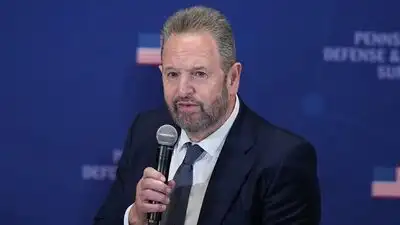
Arm CEO Rene Haas
Rene Haas, CEO of Arm Holdings, says AI could help find a cure for cancer within our lifetime. “ AI is going to… find a cure for cancer that today you and I, other humans [could] not in our lifetimes,” Haas told the BBC. Haas said understanding cancer at the cellular and genetic level remains extremely difficult. “Modelling a cell, modelling a human, modelling how a DNA marker is impacted by cancer – it’s too complex a problem, not only for humans today, but the computers that run AI,” he said. “However, going forward, as we feed more and more of the models into these computers, and the computers get more sophisticated to run the models, they’re going to solve it,” Haas noted. Chris Bakal from the Institute of Cancer Research in London said the important question is increasingly about what data is being given to AI. He said researchers are already training AI using data generated from patient samples. He said Arm-designed chips could power self-learning robots used in manufacturing, cleaning, security, construction and repairs.
As fears around artificial intelligence (AI) continue to grow, one of the UK’s biggest technology leaders has made a very different prediction about where the technology could take humanity. Haas believes that this is something humans may not be able to achieve on their own as the problem of understanding how cancer affects cells and DNA is simply too complex for humans and current computers to fully solve. But as AI models become more advanced and are trained on more data, he expects computers to eventually tackle the problem. However, Hass believes that will change as AI systems and the computers running them become more powerful. “It is not scraped from the internet. It does not need a giant data centre to run. The future of medical AI will not belong to whoever builds the biggest computer. It will belong to whoever has the right measurements,” he added. Bakal added that AI-based predictions could reduce the time needed to develop new treatments. “That kind of prediction could cut years from the time it takes to develop new treatments. This is where AI delivers real benefit to patients,” he continued. Haas also expects AI-powered humanoid robots to become widespread.
Despite discussions about strengthening the UK’s semiconductor industry, Haas does not believe the country needs to build its own chip factories. “I don’t think it’s necessary for the UK to [build] fabs. Fabs are very expensive. They take a lot of specialized workers. They take a lot of natural resources, and there’s a pretty broad ecosystem for those,” he explained. Arm remains heavily connected to the UK, with Haas saying half of its employees are still based there and that the company is “by far and away the largest employer in Cambridge. Get the latest technology news and updates. Download the TOI App.
The company has also started selling its own chips, with Haas saying demand for its newly launched products has exceeded $2 billion.
“The estimates of jobs going away and being completely replaced by machines is a bit overstated,” he said, arguing that AI would also create new opportunities. The rapid expansion of AI is currently being limited by a shortage of chips needed to build data centres, according to Haas. Arm’s technology is now used in around half of AI data centres worldwide, according to Haas.
“With artificial intelligence, these robots can see, learn, and essentially be reprogrammed for new tasks. So, in the service industry, the robot that was programmed to make a bed can also learn how to arrange the towels in a room, or clean the dustbins, or whatever you want to go off and do,” he explained . Haas also pushed back against predictions of widespread job losses. “We are absolutely in a supply-constrained environment. Can you get enough chips? We need more fabs [chip factories] before we can put a data centre in space,” he highlighted.