
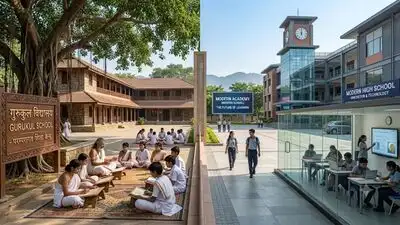
These people will rather speak about such important aspects as responsibility, resilience, and the ability to lead without being told. Long before the concept of “leadership skills” became popular, the gurukul system in India succeeded in developing leadership skills of its students by means of an appropriate lifestyle. India’s education system evaluates the youngsters mainly on the basis of their achievements in examinations. But if you talk to any employer, parent, or psychologist about what these youngsters lack in life, they will hardly mention their academic achievements. Modern schools have a lot to learn from this ancient experience, though they have a wide variety of the latest education technologies available.
10 Sept 2026 | 12:19 In the Gurukul system, the day of a pupil was not divided into forty-minute blocks followed by ringing of bells. Because teaching wasn’t confined to a fixed-length class period shared with forty other students, a guru knew a shishya’s strengths, fears, and pace of learning intimately,.
“The gurukul system succeeded because it never separated the child’s character from the child’s education; they were built in the same breath, not in separate periods,” says Mr Rishi Pal Chauhan, the Architect of Personalised Learning and Founder & Director, Jiva Group. Instead, it revolved around a number of activities like chores, discussions, physical labor, and observation of nature, along with formal education. Students did not simply read about good governance from books; instead, they saw how their guru made decisions, mediated disputes, and was accountable for the results. The ‘curriculum’ thus consisted of life itself, and leadership was assimilated rather than taught. Perhaps the most striking difference is the relationship itself. That closeness allowed for genuinely personalised guidance, pushing a confident student harder and giving a hesitant one more time, without either feeling singled out. In most contemporary schools, a teacher meets a new batch of students every year, often too large to know individually, and personalisation becomes an aspiration rather than a practice. That is the single biggest lesson modern schooling has yet to fully absorb.
Today’s classrooms, in contrast, tend to be compartmentalised into a distinct morality education period held once a week, which is completely disconnected from anything that the child does that day.
Practical knowledge acquisition was very important in Gurukul days. Cooking, farming, archery, debates, and community service were all part and parcel of students’ experience and entailed learning by doing. This meant learning to make decisions in real-life situations rather than in abstract ones. If a child has actually worked on a task, made mistakes and rectified them, he or she develops a different kind of confidence as opposed to someone who has solved a multiple-choice quiz on the same topic. Experiential learning is now a recognised pedagogical trend globally, but the gurukul was practising it long before it had a name.
Responsible leadership cannot be learned in a gurukul according to a teaching plan. None of this is an argument to abandon modern infrastructure, technology, or structured curricula that bring real, necessary advantages the gurukul never had. The argument is for balance. Institutions that intentionally develop mentorship, collaborative duty, practical activities, and close, reliable educator-learner relationships will help children become much better leaders than those that put emphasis solely on testing. It was taught through a lived, daily practice of trust, consequence, and closeness, and that is a lesson no amount of classroom technology can replace on its own. Looking for trusted parenting advice? Follow TOI Parenting Circle on Instagram for expert guidance, relatable stories, and practical tips delivered every day. Get the latest Lifestyle News and more. Download the TOI app.