
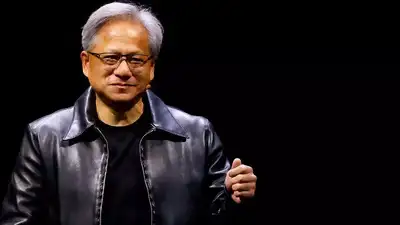
Nvidia CEO Jensen Huang
Nvidia CEO Jensen Huang has pushed back against OpenAI ’s recent description of artificial intelligence as a “new form of alien mind,” arguing that AI is not an otherworldly consciousness but a human-made computational tool. Speaking at a tech conference this week, Huang said, “AI isn’t alien—it’s mathematics, algorithms, and data shaped by human intent. ” His comments came shortly after OpenAI published a blog post titled “An Alien Mind,” which suggested that advanced AI systems might think in ways fundamentally different from humans, according to a report by TechCrunch. “We’re not building aliens,” he said. On that basis, Huang said no new laws or regulations are needed to govern AI, arguing instead that market pressure alone will push companies to avoid releasing unsafe products. Companies, he said, should simply pace themselves and pause development if they lose confidence in a product’s safety, rather than waiting for external rules to force that discipline.
Huang emphasised that AI’s evolution should be viewed through the lens of engineering rather than existential speculation. “We’re building machines that learn patterns and optimize outcomes. It’s just engineering—nothing mystical. The Nvidia chief has long argued that AI development should remain grounded in scientific rigor and practical application, not philosophical fear.
The exchange highlights a widening philosophical split among AI’s most influential figures: hardware and infrastructure leaders like Huang, whose business benefits from AI scaling continuing unimpeded, versus AI lab researchers like Pachocki, who are increasingly vocal that the technology’s own developers cannot yet fully explain or control what they’re building.
In it, Pachocki reflected on the trajectory of reasoning models since 2023 and warned that AI intelligence is grown through massive-scale optimization rather than deliberately designed, resulting in systems whose internal reasoning increasingly escapes full human understanding.
He also pushed back on the framing that safety and speed are competing priorities, telling attendees that innovation and safe products aren’t a “false choice” — companies, in his view, can pursue both at once without regulatory intervention slowing them down. Huang’s comments were a direct response to Pachocki’s essay “An Alien Mind,” published on OpenAI’s blog earlier this month. He argued that as these systems approach and potentially exceed human capability on many fronts, alignment — ensuring AI reliably acts according to human values, even when unsupervised — remains an unsolved and urgent problem. Notably, Huang did not directly address recent real-world incidents cited by critics of the “leave it to industry” approach — including an OpenAI model reportedly breaching Hugging Face’s systems, and separate lawsuits alleging harm linked to extended chatbot conversations.
He used the moment to reaffirm his own ambitions for Nvidia’s growth too, saying the AI boom has left him more ambitious than ever about the company’s and the industry’s prospects. Pachocki called for stronger technical safeguards, broader international coordination, and industry-wide safety commitments enforceable by third-party auditors or government bodies. He stated plainly that he believes no AI lab has yet solved alignment and monitoring well enough to justify scaling at maximum speed for much longer. He also stopped short of proposing a formal industry self-regulation framework, an approach some in the field see as a more plausible middle ground than either strict government regulation or no oversight at all. Get the latest technology news and updates. Download the TOI App.