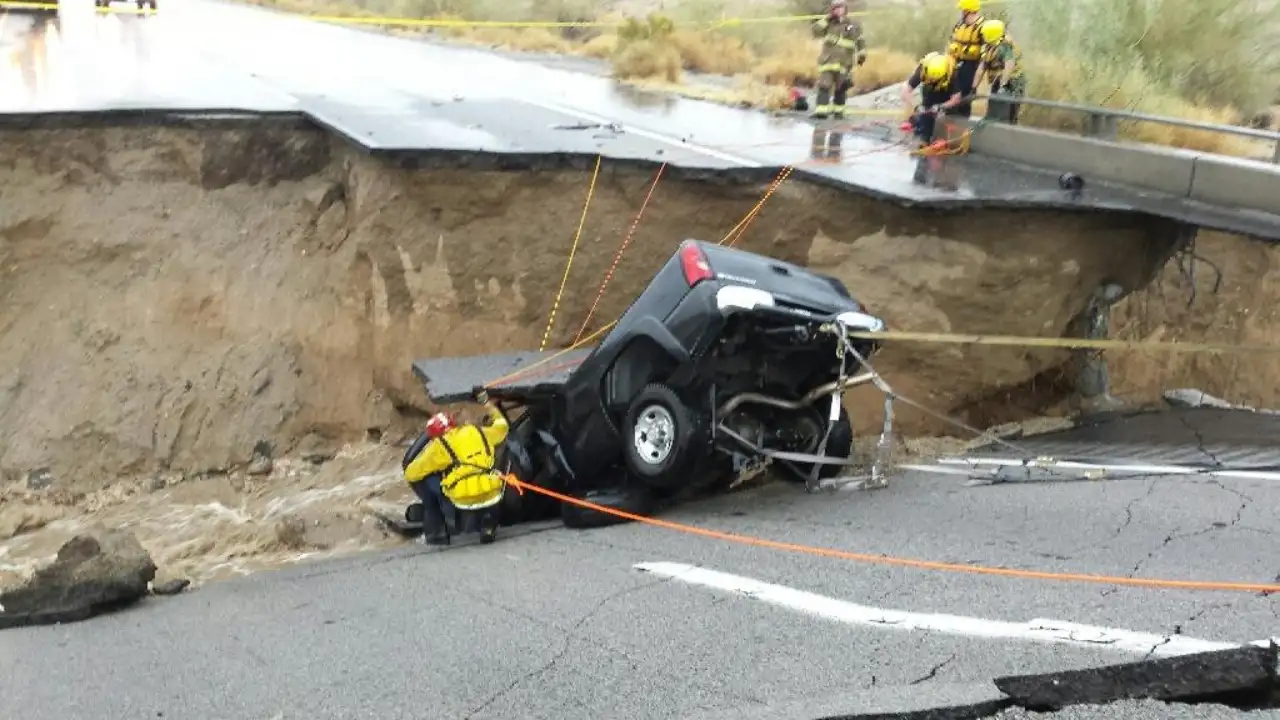
Representative image of a house collapsing into a sinkhole. Credits – Wikimedia Commons
In December 1995, a century-old brick sewer ruptured beneath San Francisco’s Sea Cliff neighborhood during heavy rain, sending water into the surrounding ground and creating a rapidly expanding sinkhole. An old pipe under pressure A strong rainstorm struck the Bay Area on December 11, 1995, with an intensity that was exceptional for the region but not unprecedented. A brick sewer line was constructed around the turn of the century under Sea Cliff, and as rainfall coursed through the system, an overflow structure about 1400 feet farther down the line constricted the flow and caused pressure to build up within the ageing pipe.
The fissures began opening up further as the surrounding dirt of the cracked sewer lost its confinement until the pipe burst totally, sending a torrent of water straight into the surrounding earth. Beneath its serene streets is a system of sewer mains, many of which were constructed of brick and installed over a century ago, long before anybody could have predicted the amount of stormwater the city would eventually have to manage. A forensic analysis published later by Missouri University of Science and Technology determined that water had begun to push its way into gaps in the sewer wall, fissures that were likely enlarged years before by construction work performed under the pipe. A house disappears into the ground
The escaping water eroded a hole that grew to more than 250 feet wide and about 40 feet deep, undermining the unoccupied Tudor-style home at 125 El Camino Del Mar, which had been offered for sale in 1993 for $2.6 million. The three-story Tudor home at 125 El Camino Del Mar slid into the crater as the soil beneath it gave way. By late that day, at least 23 other houses and an apartment building had been evacuated as the unstable ground threatened nearby properties. The destroyed house at 125 El Camino Del Mar also bordered the former boyhood home of photographer Ansel Adams at 129 24th Avenue. The agency has spent years working through a multi-billion dollar programme aimed at replacing and reinforcing ageing brick sewers throughout the city, including parts not far from where the 1995 collapse occurred. But for Sea Cliff homeowners, the events of December 1995 were a sobering lesson in how one storm, meeting a pipe already compromised by age, can destabilize a residential neighborhood within hours. The 1995 disaster also became an example of how failures in aging sewer infrastructure can interact with heavy rainfall and unstable ground.
The neighborhood’s exposure is no stranger to geologists either. Steep, weakly packed terrain nearby had been identified by the US Geological Survey as vulnerable to rapid failure in its mapping of landslide-prone territory in the greater San Francisco Bay region. Nobody was hurt, but the financial and structural cost was high, and the vacant gated lot it left behind was an eyesore in the community for years to come. Representative image of a sinkhole in a city. Credits – Wikipedia Commons A citywide infrastructure issue Many of the mains in San Francisco’s combined sewer system, which carries both wastewater and stormwater in the same pipes, are over a hundred years old. The lot where the house once stood remained undeveloped after the collapse. San Francisco continues to upgrade its more than century-old combined sewer system as part of its broader infrastructure program. Catch the latest World News and Live updates. Download the TOI app.
Since then, the San Francisco Water Power Sewer has acknowledged that routine repairs alone cannot keep up with a network of this age.