
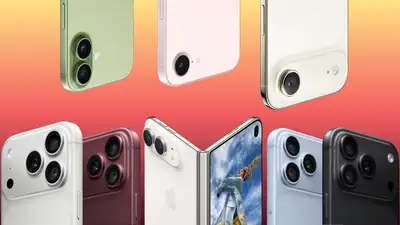
iPhone 18 Pro, Duo, or the 17?
Apple’s first folding iPhone opens to a 7.6-inch inner display with a nano-texture finish that cuts glare and keeps the crease from catching light. Closed, the 5.4-inch outer screen gives you about 90 per cent of the screen area of an iPhone 18 Pro, which is the part that matters. The body is grade 5 titanium with a 3D-printed hinge cover, and the hinge itself is built from over 100 components. Ceramic Shield 2 covers the front, Ceramic Shield protects the back, and it carries an IP68 rating. It runs the same A20 Pro as the 18 Pro, with a vapour chamber and a battery on each side of the fold, rated at up to 31 hours of video playback on the inner display and up to 44 hours on the outer one. The folding design brings its own camera tricks, including Duo Preview, which puts a live preview on the outer screen so your subject can see their own framing, and Smart Take, which fires the shutter on its own when it decides people are posing. iOS 27 has been reworked for it, with Split View for two apps side by side and a Dynamic Island that runs vertically down the side of either screen. Pre-orders open on October 16 and it ships on October 23, so nobody is buying this today regardless. Skip it: If you want a telephoto lens, Apple Reference Image or variable aperture, all of which the 18 Pro has and this does not. Price: Starts at Rs 1,64,900 Who’s it for: Photographers, video shooters and anyone who uses the camera as part of their work. The 48MP Fusion Main camera now has a variable aperture, with six laser-cut blades that move between four settings from f/1.48 to f/4.0. You keep the same 8x telephoto reach, ProMotion and 39 hours of video playback. You would be paying Rs 65,000 over the iPhone 17 for tools you will open twice and then forget. Price: Starts at Rs 1,79,900 Who’s it for: People who spend hours a day watching, reading or working on the phone. The extra Rs 15,000 buys a 6.9-inch display and a larger battery, and Apple India lists up to 43 hours of video playback on it. Apple’s headline numbers of 45 hours on the Pro Max and 36 hours on the Pro apply to the eSIM-only versions sold in the US, Japan, the UAE and a few other markets, where losing the SIM tray made room for a bigger cell. If the big screen is what you are after rather than the new camera, last year’s Pro Max is the same 6.9 inches and is now going for considerably less than Rs 1,79,900 through sellers who still have stock. The 6.3-inch Pro gives up screen size and running time and nothing else. Price: Starts at Rs 1,49,900 Who’s it for: Buyers who want the thinnest iPhone and have already decided that is what they are paying for. The Air gives you one 48MP camera, 27 hours of video playback, no macro and an eSIM-only design. Apple has not changed that equation since last year, and the 18 Pro has closed in on it. Rs 15,000 more now buys three cameras and a considerably stronger chip, which is a harder comparison than the one the Air faced in 2025. Price: Starts at Rs 99,900 Who’s it for: Almost everyone. You get a 6.3-inch ProMotion display at 120Hz, the A19 chip, a 48MP dual camera system with macro, an 18MP Center Stage front camera that shoots landscape selfies without turning the phone, and 30 hours of video playback. Coming from an iPhone 13 or 14, this is the biggest jump you can get for the money, and the display is the part you will notice on day one. Coming from a 16, the gap narrows to the screen and the front camera. If the missing zoom is the one thing stopping you, look at what a discounted 17 Pro is selling for before you settle. A standard iPhone 18 is expected in the first half of next year, so the 17 you buy today is further into its cycle than the price suggests. Price: Starts at Rs 79,900 Who’s it for: First iPhones, second phones, and phones bought for someone who will never read a spec sheet. You get a 6.1-inch display, the A19 with a 4-core GPU, a single 48MP camera with 2x optical-quality zoom, 26 hours of playback, MagSafe charging and 256GB of storage at the starting price. Skip it: If you are used to a high refresh rate screen, or if you can find the Rs 20,000 it takes to get to the iPhone 17. Price: Starts at Rs 89,900 Who’s it for: Only buyers who find it discounted well below what Apple is asking. Apple is charging more for a two-year-old phone with the A18 chip, 22 hours of playback and no ProMotion than it charges for the newer 17e. Skip it: At Rs 89,900, without thinking twice. The 17e costs Rs 10,000 less and is newer on every count. The iPhone 17 is the answer for most people, and if your current phone can survive until the standard iPhone 18 arrives next year, waiting is the smarter. The 18 Pro earns its price if photography is part of your job, and the Pro Max only if you care more about hours than about pocket space. The 17e is the sensible end of the range, and the 16 is not worth its listed price. At Rs 2,99,900 it is not competing with anything else here, and you already know whether you are one of the people buying it. Do it the other way round and you end up with the 18 Pro.
Because there is no room for Face ID on both screens, touch ID is in the side button,. Apple has stopped selling the 17 Pro, which means third-party sellers and the second-hand market now set its price, and that price tends to fall fast in the weeks after a launch. Because a real discount is the only thing that puts this phone back in the conversation, check what third-party sellers are asking before you write it off completely,.
Plenty of foldables make you tolerate the outside screen until you can open the thing. This one does not. Both displays run the same aspect ratio, so content does not rearrange itself when you unfold. Cameras are a 48MP Fusion Main with 2x telephoto and a 48MP Fusion Ultra Wide, plus a Center Stage front camera and a second FaceTime camera hidden under the inner display. Also skip it if you would rather not be among the first people living with a new hinge design for the next two years. Left on automatic, the phone decides for itself, opening up in low light and stopping down when a group shot needs the back row in focus. The new Pro controls in the Camera app hand you aperture, shutter speed and white balance, with a histogram to check exposure across the frame. If you have spent years wishing an iPhone would stop making these calls for you, this is the release that finally listens. There is also Apple Reference Image, an opt-in mode where the sensor signs the pixels it captures and produces an unaltered version of the shot that sits alongside the edited one in Photos, so you can compare the two and see what moved. Apple is aiming it at photojournalists and anyone who has to prove a picture was not touched. There is a cheaper way into a Pro iPhone, though. You lose the variable aperture, Reference Image, the A20 Pro and the newer cooling. For a lot of buyers, that is most of a Pro iPhone for a good deal less money. Skip it: If you have never once wanted manual control over a phone camera. The two Pro models are identical in chip and cameras. The battery figure needs a second look, though. India still gets a physical SIM slot, so those are not your numbers. Skip it: If large phones have ever defeated you. In return you get a titanium body thinner than anything else Apple sells, and the A19 Pro running it. If you are buying this phone, you are buying how it feels in your hand, and there is nothing wrong with that. Just do not go looking for a spec sheet that agrees with you. Skip it: If you shoot often, if you travel on local SIMs, or if you need the price to add up on paper. It takes a specific requirement to move off this one. What you miss against the Pro is telephoto reach, the variable aperture and the headroom for sustained work. Most people will never run into any of it. Now that Apple has taken it off the shelf, the gap between the two is smaller than the sticker prices suggest, and a telephoto lens is not something you can add later. The timing is the other thing to weigh. Apple has split its release calendar, launching the Pro models and the foldable in September and leaving the standard tier out of it. If your current phone is still holding up, sit out a few months and let the calendar work for you. Skip it: If you need long zoom, or if you can manage until the next standard model lands. What Apple has taken out is ProMotion, the Dynamic Island and Camera Control. The last two you will stop missing inside a week. The 60Hz display is the one that sticks, and you will see it every time you scroll, particularly if you are coming off a 120Hz phone. That is the whole story here. Everything else is a specific case. The Air is a purchase you make with your hands, not a spreadsheet. Apple no longer sells it, which is why it is worth watching for the next few weeks. The Duo sits outside this argument altogether. Forget which one is newest. Work out what you will actually do with the phone, then look at the price list. In that order, this lineup is simple. Get the latest technology news and updates. Download the TOI App.
The one buy that cuts across all of it is last year’s Pro.
Apple’s iPhone lineup in India now runs from Rs 79,900 to Rs 2,99,900, and for the first time in a while, working out which one to buy is not as simple as picking the newest thing you can afford. The 18 Pro and 18 Pro Max reach stores today with a new chip and a moving camera in a familiar silhouette. As usual, the 17 Pros are gone from Apple’s own store, and will now be found wherever discounts and second-hand listings take them. But there is no new regular iPhone this year, which leaves last year’s 17 holding the mainstream slot at a price higher than the one it launched at. And at the bottom of it all, the two-year-old iPhone 16 costs Rs 10,000 more than the newer 17e. Price: Starts at Rs 2,99,900 ( pre-orders start October 16 ) Who’s it for: Buyers who want the foldable now and are not worried about what a second version might fix. Apple rates its 7-core GPU at up to 40 per cent faster than the A19 Pro, and the Dual 16-core Neural Engine handles twice the AI processing of last year’s chip. The vapour chamber under it has three times the surface area of the one in the 17 Pro, which is where the claim of up to 40 per cent better sustained performance comes from. The 6.3-inch model starts at 256GB and goes up to 2TB, in black, silver, glacier and a new burgundy.
There is a folding iPhone, which costs almost three lakh rupees. So here is every iPhone Apple is currently selling, what each one actually gives you, and who should walk past it. There is no talking anyone out of this one. If you have decided you want a folding iPhone, you are buying a folding iPhone, and the rest of this list is academic. For everyone still deciding, here is what the money gets you. The A20 Pro is built on a 2nm process. You will see that in long video recordings, long gaming sessions and heavy on-device AI work. You will not see it while checking WhatsApp.