
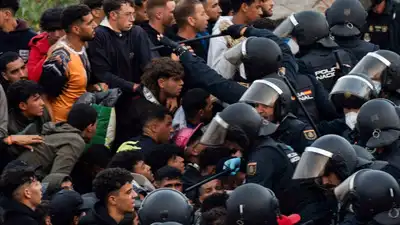
Police escort migrants from Benitez Beach to be relocated to the camp set up at the port of Ceuta (Photo: Reuters).
The operation follows an unprecedented surge at the border in late July, when more than 72,000 people crossed into Ceuta from Morocco. Most subsequently left the territory, but Spanish authorities estimate that around 10,000 migrants remain. Authorities have set up temporary accommodation at Ceuta’s port with a capacity for 1,700 people. The operation to clear the beaches began shortly before 7 am and involved Spanish riot police as well as military personnel. One NGO estimated that around 4,000 migrants were still sleeping outdoors on Ceuta’s beaches and pavements.
NGOs, however, said thousands of migrants remained without shelter and were sleeping rough in makeshift camps. Migrants who had spent the night on the beach hoping to secure a place in temporary accommodation initially applauded as the operation began, according to Reuters. Three NGO leaders told Reuters that authorities had been too slow to provide the minimum shelter required under the European migration pact. They said the reception centres opened so far also lacked sufficient capacity to accommodate migrants still living on the streets.
Tensions later escalated, with clashes breaking out as people competed for the limited spaces available. Most of those remaining are reportedly men and boys. Since the temporary accommodation has been designed only for adult men, minors are being separated and housed elsewhere. This means the newly opened centre is unlikely to be sufficient to clear the makeshift camps from public areas. Catch the latest World News and Live updates. Download the TOI app.
Spanish riot police fired rubber bullets into the air and used batons on Friday as authorities began clearing thousands of migrants from beaches in the North African enclave of Ceuta, with some being moved to temporary accommodation.