
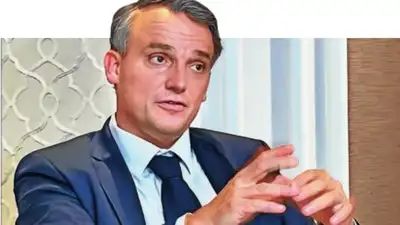
Christian Klein, CEO of SAP
In 1714, English engineer Henry Mill submitted a patent for a “machine transcribing letters”. This laid an early foundation for the technology that would eventually lead to the typewriter and modern keyboard. More than three centuries later, SAP CEO Christian Klein believes another shift could be coming, this time driven by artificial intelligence (AI).
So we are now building, with agents, an end-to-end planning scenario which helps them optimise inventory by 20%.
Klein says employees may stop entering business data by typing within the next two to three years as voice recognition and AI agents become more capable. “The end of the keyboard is near,” he told Fortune. For SAP, the shift could change how businesses interact with their core systems. Klein says AI-powered voice recognition has already become strong enough to handle many tasks. The technological capabilities are there, it really is now about the execution.” He also said that SAP is giving its AI tools more skills so they can handle increasingly complex workplace tasks. Klein believes companies need to use AI across different parts of their operations instead of limiting it to individual departments. He points to a consumer goods company working with SAP to connect demand planning, financial planning, inventory management, procurement, and manufacturing. The company is building an AI agent-based planning system that could optimise inventory by 20%. “They said, ‘Okay, this agent really is predicting the demand much more intelligently than all the human beings I had in planning,’” he said, according to Klein. This is real money.” Klein also expects AI to make it easier for employees to analyse large amounts of existing company information. “An employee can say, ‘Hey, go into my PowerPoint presentations,’” Klein notes. I don’t expect that this will change anytime soon,” he argued He said companies need infrastructure flexibility so they can move their platforms between different cloud providers if sanctions, export controls or other geopolitical changes affect operations.
He believes employees will increasingly use voice commands to ask analytical questions, trigger workflows and enter information into enterprise software. The challenge now is connecting spoken instructions with business language and data. He explained, “The future will be, for sure, that you are not typing any data information into an SAP system. You can instead ask certain analytical questions with your voice. You can trigger operational task workflows. You can also make entries in the system with your voice—performance feedback, pipeline entries, et cetera. “But it still always takes months until I adjust the inventory—and the inventory is dependent on procurement and the manufacturing side. “They can give an AI model a million financial analysis PowerPoints. We then need to make sure, with our AI, that the business data is understood and that we can do the analysis right away. The employee can then say, ‘Tell me, from the millions of documents we created in the financial department, what would be the right measures to tackle some of the challenges we see in the financial performance of the company? “That is the future of work. And then, hopefully, they get it beautifully packaged up, with some nice graphs and commentaries, some nice analysis and recommended actions, and then they can go to their managers, who say, ‘Wow, this is a new way of steering this company. My God, what did you do? Which training did you attend? And they say, ‘No, there is no training,’” he added. Klein also highlighted the growing importance of geopolitical issues for global technology companies. Different countries are introducing data, cloud and sovereignty requirements, which can make global software infrastructure more complicated and expensive. “There are two superpowers in the world, and they’re using the power to have more influence. Get the latest technology news and updates. Download the TOI App.