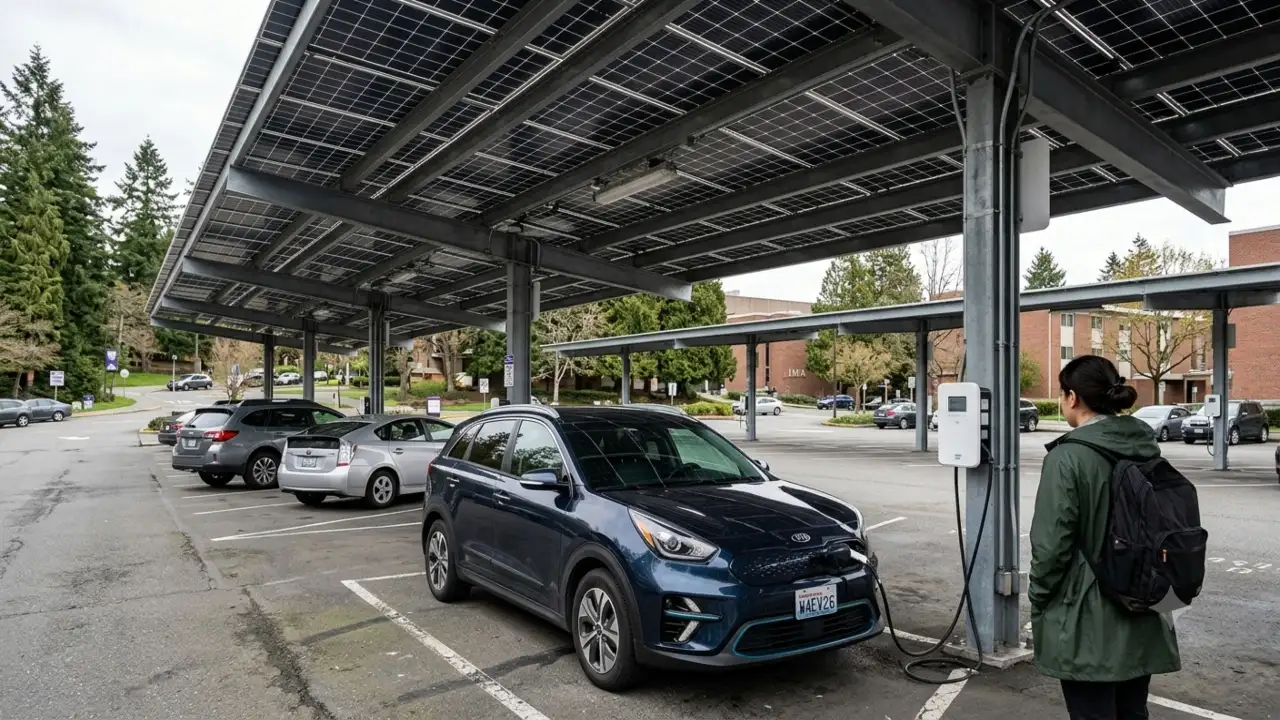
AI-generated representative image showing a solar canopy covering parking spaces at the University of Washington, with electric vehicles charging underneath. Credits – Google Gemini
The canopy, finished in February 2026 as a pilot project between UW Transportation Services and student-led group UW Solar, produces 86.4 kW that currently feeds directly into the university’s electrical grid . The installation also adds 20 new electric-vehicle charging slots, giving students, staff and visitors a place to plug in while their cars rest under the panels during the day. For now, the 86.4 kW the canopy generates feeds directly into the university’s electrical grid rather than to the chargers specifically, but the pairing signals how UW is thinking about parking lots as multi-purpose infrastructure rather than single-use space. Its public notice described plans for a roughly 4,820-square-foot canopy above 30 parking spaces, designed to connect eventually to both the City of Seattle’s grid and the university’s own, a dual link intended to let the system feed power in more than one direction once fully built out. Planners see potential for canopies across the entire E18 lot and the adjacent E01 lot, which together could generate up to 8 MW, enough to cover about 5 per cent of the university’s total electricity demand. That 5 per cent figure might sound modest on its own, but for a campus of UW’s size, even a single-digit share of total demand met through on-site solar represents a meaningful dent in the electricity the university would otherwise have to buy from off-campus sources. The E18 canopy is part of a broader 2050 Sustainability Action Plan that treats parking lots as an underused resource rather than dead space.
The canopy sits above the existing rows of cars rather than replacing them, so no parking capacity is lost. When it comes to adding solar power on campus, universities often focus on rooftops, but the University of Washington saw promise in its parking lots as well. The university has constructed a solar canopy over Lot E18, a length of asphalt north of Husky Stadium, that converts hundreds of parking spots into a source of renewable electricity without taking any spots out of use. Pairing solar canopies with EV charging in the same footprint means the same parking spot that shelters a car from rain or sun can also help power that car’s next drive, at least in theory once battery storage or smarter routing of the canopy’s output is added. Transforming a former landfill into an energy asset The site was not chosen by accident. Lot E18 sits on land that was once Union Bay, then a city landfill, then a parking lot, and the university saw a chance to put a site with a complicated environmental history to better use. Union Bay’s shift from wetland to landfill to parking lot reflects a pattern common across many American cities, where low-lying land near a body of water was filled in over decades of urban expansion and only much later reconsidered for restoration or reuse. Turning part of that legacy into a renewable energy source adds a new chapter to a site that has already changed use several times over the past century. Before construction, the university filed environmental documents outlining the scope of the work. AI-generated representative image showing an electric vehicle charging beneath a solar canopy at a university parking lot. Credits – Google Gemini A pilot with space for growth What’s compelling about the E18 canopy isn’t what it is now, but what it could become. At a ribbon-cutting for the project, UW Solar’s academic adviser and student leaders called the installation a template for what the rest of campus could one day follow. Much of the campus still relies on natural gas for heating and cooling steam, and cutting that reliance is central to the university’s long-term sustainability strategy. If the larger expansion goes ahead, a lot best known for tailgating before football games could end up as one of the more significant sources of renewable power on campus. Catch the latest World News and Live updates. Download the TOI app.