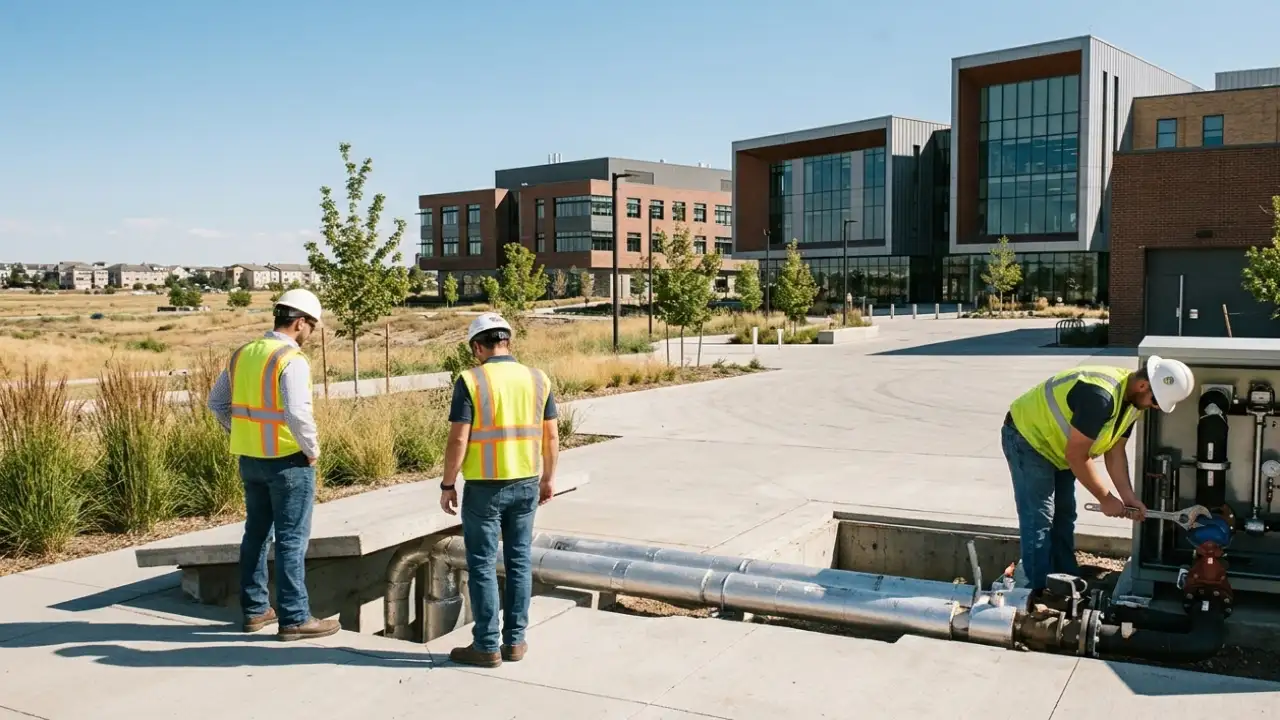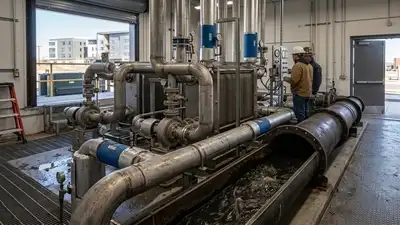
AI-generated representative image showing heat-recovery equipment that transfers thermal energy from wastewater to a separate building-energy system at Denver’s National Western Center. Credits – Google Gemini
Engineers created a system beneath the National Western Center, a 250-acre complex in north Denver focused on agriculture, food innovation and western history, that sucks heat directly out of sewage flowing through the city’s pipes and uses it to heat and cool buildings above ground. The system, which came online in April 2022, now meets about 90 per cent of the heating and cooling needs of multiple campus buildings, including the Vida and Terra buildings at the Colorado State University Spur campus and a nearby event centre. The plant, anchored by two SHARC 880 units from equipment manufacturer SHARC Energy, processes over 3,000 gallons of untreated wastewater per minute as part of a 3.8 megawatt district energy network and is the largest sewer heat recovery system in North America, according to SHARC Energy.
Most towns treat and dispose of wastewater, but Denver captures the heat before it goes out the door. Getting heat from an unexpected source The idea behind the technology is simple, but the engineering can be complicated. The wastewater from houses and businesses is usually at a rather constant temperature throughout the year, roughly in the mid-fifties to mid-seventies degrees Fahrenheit, independent of the weather outside. In winter, a heat exchanger extracts heat from the wastewater and transfers it to a separate loop of clean water that is supplied for heating to surrounding buildings. In summer, the same system runs backward, drawing heat out of the buildings and instead rejecting it into the wastewater. It’s a way of employing the sewage as a cooling source.
An article describing the project’s development, which appeared in Colorado State University System , details how the 18-month design and construction effort relied on a consortium led by CenTrio, the district energy firm that runs day-to-day operations at the facility. When the first phases of the National Western Center are fully built out, the heat recovery plant is expected to prevent around 2,600 metric tonnes of carbon dioxide emissions each year, which is roughly equivalent to removing about 6.5 million miles of vehicle travel from Denver’s roads each year. That separation between the wastewater and the clean water loop keeps the two systems fully isolated, with no contamination risk to the buildings served. AI-generated representative image showing district-energy infrastructure serving buildings at Denver’s National Western Center. Credits – Google Gemini A growing system Moving the project from concept to execution involved rerouting a large piece of city infrastructure. Denver-based Saunders collaborated with engineering firm AECOM. Instead of individual boilers and chillers for each building, the system extracts thermal energy from a sewer pipeline nearby and distributes that energy through a closed-loop network. This approach, known as district energy, is typically more efficient and cheaper to maintain over the life of the system than individual building systems. There is a strong environmental rationale for the system. The system already serves seven buildings, with more than one million square feet of space, and its designers built in capacity for further expansion when more parts of the campus come online in future construction phases. For a city looking to reduce its dependence on natural gas, extracting heat from something as unglamorous as sewage offers a realistic solution to an age-old problem, taking energy that would otherwise be flushed down the drain and putting it to use warming the buildings above it instead. Catch the latest World News and Live updates. Download the TOI app.