
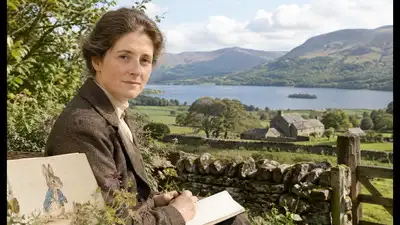
Beatrix Potter
Margaret Lane, in her 1968 biography of Potter, described the farm as a symbol of freedom to its owner. In 1905, Potter became engaged to Norman Warne, her editor at Frederick Warne & Co. A 1916 letter to Eleanor Choyce, a farmhand Potter employed during the First World War, gives an unusually detailed picture of Hill Top. Potter described the farm as covering 120 acres, including 9 acres of arable land, with 2 horses, 9 or 10 cows and 60 sheep, 47 of them lambing ewes.
The National Trust says she also threw herself into running Hill Top while continuing to work on more of her “little books”. Hill Top represented something very different from Potter’s life in London. She had spent many summers in the Lake District from childhood and regarded the countryside as a place where she could work and pursue her interests away from the restrictions of her family’s London life. The National Trust describes Hill Top as a refuge that became a place of independence and inspiration. The purchase also came during a period of personal upheaval. Warne died suddenly just four weeks after proposing. Potter responded by throwing herself into her work and continued producing the children’s books that had begun to make her successful. Potter was a lifelong learner when it came to Lakeland farming. She worked closely with experienced farmers and shepherds and became particularly committed to breeding Herdwick sheep, a native Lakeland breed. Her correspondence shows how closely she involved herself in the day-to-day management of her land and livestock. She also mentioned poultry, an orchard, a flower garden and vegetables, as well as the Cannon family, who had worked on the farm for years.
Beatrix Potter used the success of The Tale of Peter Rabbit to buy Hill Top, a 17th-century farmhouse and 34-acre farm in the Lake District village of Near Sawrey, in 1905. Potter was 39 and had already published six books with Frederick Warne & Co when she bought the property with proceeds from Peter Rabbit and a small inheritance from an aunt. Over the following decades, her interests shifted increasingly from writing towards farming, land management and conservation, and by the time of her death in 1943, she had built up a substantial estate that she left to the National Trust.
Because she was expected to spend much of the year with her parents in London, Hill Top quickly became both a working farm and a source of inspiration for her writing, although she could not live there permanently at first. She hired a property manager and began learning about Lakeland farming, eventually developing a particular commitment to Herdwick sheep.