
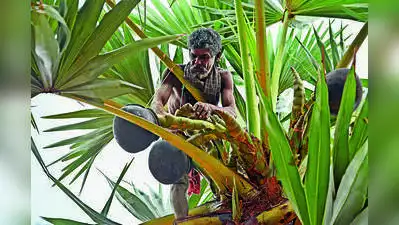
A palm tree climber at work
Tapping of unfermented sap from coconut, palmyra and other palm trees has been a continuously regulated activity under Tamil Nadu Prohibition Act, 1937 since as early as the year 1939, when the state first framed Tamil Nadu Neera or Padani Rules, 1939 for this very purpose. Tamil Nadu Neera Rules, 2017, in their own preamble, expressly record that they are made ‘in supersession of the Tamil Nadu Neera or Padani Rules, 1939’, the state submitted. The state govt has promulgated various Rules under Section 54 of the Tamil Nadu Prohibition Act, 1937, permitting the manufacture, stocking, distribution, sale and consumption of IMFL, beer, etc., where production is confined to a limited number of licensed manufacturing units capable of being closely watched and monitored.
Therefore, there was no discriminatory approach; rather, the differential treatment rests on an intelligible differentia—monitorability and public health risk—having a rational nexus with the objective sought to be achieved, namely, the prevention of consumption of adulterated and unsafe intoxicating liquor. You Can Also Check: Gold Rate in Madurai | Silver Rate in Madurai | Bank Holidays in Madurai | Public Holidays in Madurai | Madurai AQI | Weather in Madurai | Petrol Price in Madurai | Diesel Price in Madurai | CNG Price in Madurai | LPG Price in Madurai Stay updated with the latest Madurai news. The state submitted that toddy has low alcohol strength and is normally adulterated with stupefying substances such as chloral hydrate and datura (atropine) in order to enhance its inebriating effect. When chloral hydrate is dissolved in toddy, it mixes thoroughly and cannot be differentiated from genuine toddy. Such adulterated toddy is highly harmful to consumers, even fatal, and its consumption cannot be closely watched or monitored. In the case of toddy, every palm tree is, in effect, a manufacturing unit and it is not possible to monitor production under each and every palm tree individually. Adulteration could occur at any point, from tapping to selling at the toddy shops. It is only against this background that the govt took the policy decision to ban the tapping of toddy. The state submitted that tappers are already free to tap neera/pathaneer (in the case of coconut) and padani (in the case of Palmyra, date and other palm trees), which can be sold as such without any further conversion and the same is being marketed through Tamil Nadu Palm Products Development Board. No corresponding rule has been, or could be, framed for the manufacture, retail or consumption of fermented toddy, since every palm tree is, in effect, an individual manufacturing unit incapable of centralised monitoring, and adulteration may occur at any stage. A division bench of Justice C V Karthikeyan and Justice R Sakthivel sought a response from the state while hearing a public interest litigation filed by advocate G Thirumurugan alias Theeran Thirumurugan. The petitioner sought a direction to the state govt to formulate an appropriate policy for permitting regulated tapping, manufacture, transportation and sale of natural palmyra and coconut toddy in Tamil Nadu. Download the TOI App.
Madurai: Citing difficulties in monitoring adulteration during toddy tapping and sale, the state justified its policy decision to prohibit tapping and sale of toddy in Tamil Nadu before Madras high court on Monday.