
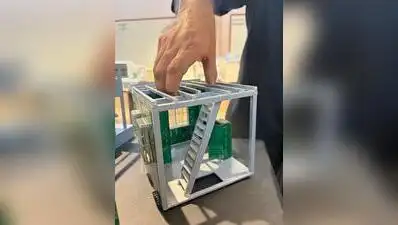
Mumbai: Seventeen spanking new buildings have cropped up overnight in the heart of Dharavi . Between two and four storeys high—but no taller than two feet—these model toolhouses are on display at a pre-primary school in Dharavi Koliwada, the product of an ethnographic inquiry into aspirational housing.
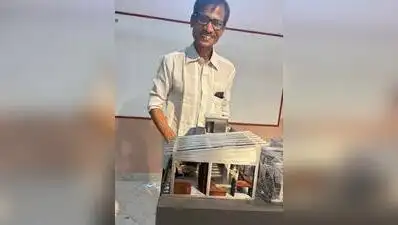
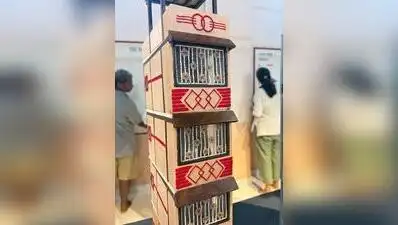
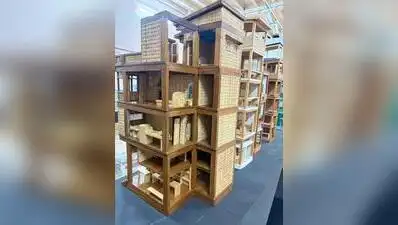
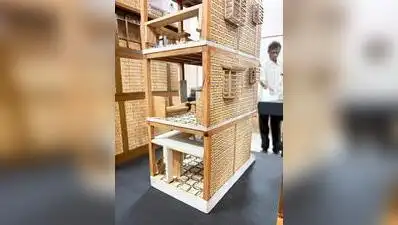
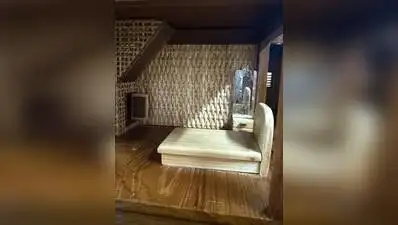
In 2019, the urban research collective urbz, which has been working in Dharavi since 2008, started to engage with 17 families in Sangam Gully, an old neighbourhood, to document their version of an ideal toolhouse—a term urbz coined to define a building typology where home and workspace cohabit. The project Homegrown Street is the second phase of their 2017 project Design Comes As We Build, where contractors who build in informal neighbourhoods were issued a similar brief: to design the best house they could imagine. They conveyed these accounts to 17 contractors who worked with artisans to create a scale model, complete with miniature furniture and bathroom fittings.
“People would tell us, for instance, that they’d like a house with an upper floor for their sons and a floor above that they could lease for an additional income,” says Kareena Kochery, a partner at urbz. “Dharavi as a place is considered informal, as having no real form; we wanted to highlight the skills that gave it form,” she says. “Each model took 15-20 days to make,” he says. “Clients continue to build as and when they come into money, adding a room here or conveniences there,” he says. The prospect of redevelopment has done nothing to diminish this drive: “People still want to improve their homes.”
Their designs were then given form by Dharavi’s artisans, skilled in woodwork, leatherwork, metalwork and glasswork. The initial project was a tribute to artisanal craft and the ingenuity and adaptiveness of contractors—whose expertise in informal built environments accommodated both spatial constraints and client demands. The current project additionally archives a community’s aspirations. Every house on Homegrown Street shapes a vision. Some are within steel frames; others are bound by wood; all are hand-tooled with found material: circuit boards, old jeans, wood scraps, cane, beads, embroidered cloth. Kochery describes the project as both urban fiction and a living archive of a neighbourhood on the brink, and yet vital as a built urban typology that houses half the city affordably. Some of these belong to Manoj Kumar Biskarna, a contractor and craftsman who has built a couple of the toolhouses and the wooden fixtures within them, including miniature sinks, taps and commodes. Biskarna lives in Thane but has built offices and houses in Dharavi.
Sept 24-27; 10 am-7 pm at Dharavi Koli Jamat Preprimary School, near Guru Dutt Gym, Dharavi Koliwada You Can Also Check: Gold Rate in Mumbai | Silver Rate in Mumbai | Bank Holidays in Mumbai | Public Holidays in Mumbai | Mumbai AQI | Weather in Mumbai | Petrol Price in Mumbai | Diesel Price in Mumbai | CNG Price in Mumbai | LPG Price in Mumbai Stay updated with the latest Mumbai news.
I thought, if they could be built there, why not in Dharavi?” he says. Sanjubhai Hinduja wants a new home altogether, and although he wishes it could have resembled his model toolhouse, he’ll make do with a redeveloped flat. “The ideal house I described to urbz was based on houses I’d seen in Bandra and South Bombay. “Now, it’s too late. But I welcome redevelopment—it will be an improvement. Download the TOI App.