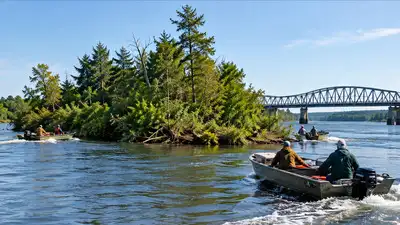
AI Representation: Wisconsin boaters have used their own boats to push a 40-acre floating forest away before wind and currents trap it against their only bridge. Image credits: Chatgpt
On the Chippewa Flowage in northern Wisconsin, there is a 40-acre patch of forest that has no fixed address. A 1923 flood project turned buried swampland into open water Chippewa Flowage, also called Lake Chippewa, is a lake that is 15,300 acres and is located in Sawyer County, Wisconsin. It is 15 miles east of Hayward. It’s the third-largest lake in Wisconsin, with an irregularly shaped, mostly undeveloped shoreline stretching 233 miles and encompassing over 200 undeveloped islands, per the Chippewa Flowage Joint Agency Management Plan. Local stories indicate that this phenomenon could also be responsible for the floating bogs observed in the Chippewa Flowage following the flood of 1923. Reports of the effort involve anywhere from 20 to 50 boats nudging the bog back into the lake with synchronized surges that might even use walkie-talkies for coordination, and at a speed of much less than a mile per hour. It takes many hours to do this, and a strong wind gust could undo all the hard work in just seconds, turning the bog 30 degrees or more off its course. New bogs may be formed even after the flood of 1923, since new parts of organic matter continue to be released from the lake bed.
The Chippewa Flowage was formed in 1923 due to the flooding of a large swamp area caused by the Winter Dam for hydropower production, according to the Wisconsin Department of Natural Resources . Since the bog is considered a wildlife habitat and is therefore protected, there is nothing else to do but move it aside.
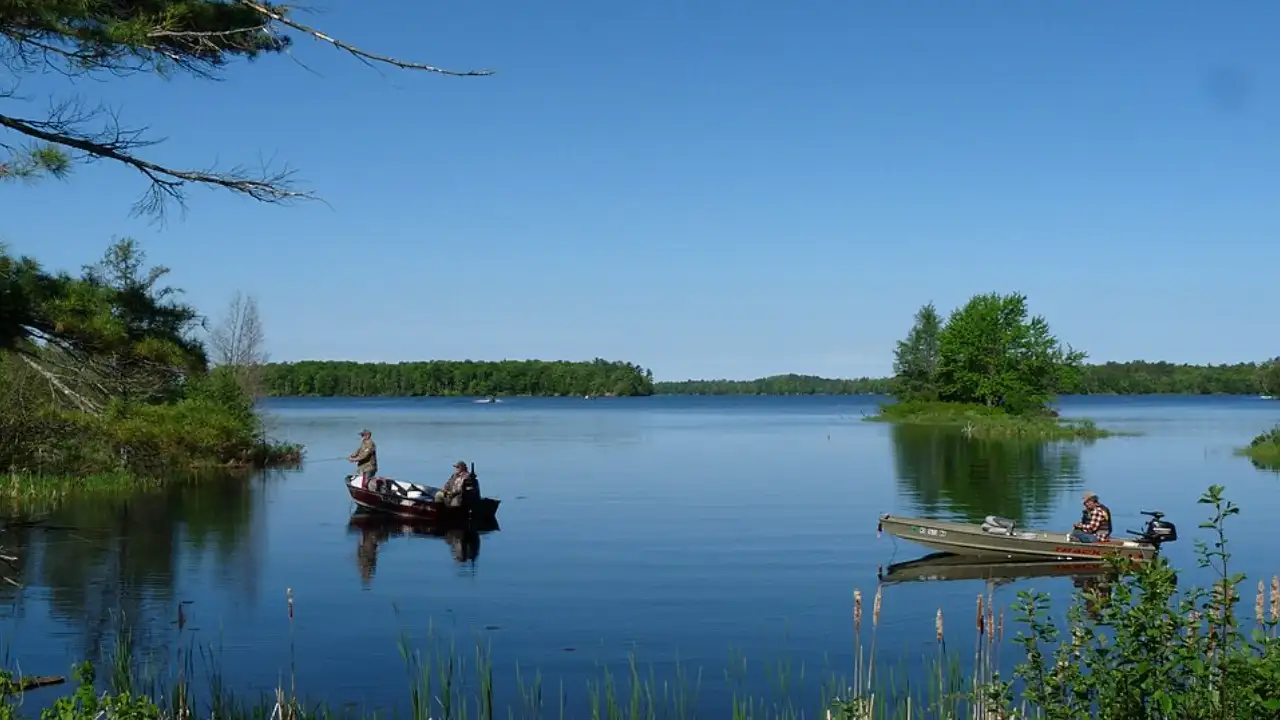
The tamarack trees behave just like sails in that the wind moves the entire bog, covering several miles over the lake’s surface, according to the locals. It drifts across the lake’s western side on its own schedule and when the wind is wrong, it drifts straight toward the only bridge connecting the flowage’s east and west sides. When that happens, there is really only one practical option locals have found: boat owners gather, sometimes twenty of them, sometimes fifty, and use their bows to push the floating forest out of the way. Since the lake’s formation, the people here have had to cope with these floating bogs, and nothing suggests the problem is resolving itself. It cannot be divided into pieces and then cleaned up since it is considered an ecological zone that shelters its own plant and animal species. The people only have one choice: to move it around for a bit. Submerged peat bogs rose to the surface after the flooding As the years went by, organic matter submerged by the flooding gradually rose to the surface, providing a base for plants and creating floating bogs. The anaerobic breakdown of the plant material results in the formation of gases like methane and carbon dioxide, which make it buoyant. This is a phenomenon that has been well documented to occur in peat bogs all over the world. Within the next few years, with the help of the winds and birds, seeds started growing on these new floating islands of peat, soil, and roots, creating grass and trees on these floating pieces of land. The Forty Acre Bog grew mature tamarack trees on the lake’s west side These floating bogs vary greatly in their sizes; some are not more than the size of a car park, while others cover several acres. The Forty-Acre Bog, which is one of the most extensive and well-known floating bogs of the Chippewa Flowage, exists on the western part of the reservoir. Fishing on the Chippewa Flowage in northwest Wisconsin. Image credits: Wikimedia Commons Over the years, this bog has grown into a community of tamarack trees, whose branches catch the wind and set the whole bog adrift. The bog regularly drifts toward the flowage’s only bridge That’s largely a matter of geography. A bridge crosses the flowage, connecting its eastern and western shores, and it sits directly in the path the Forty Acre Bog tends to follow. When wind and currents shift, they push the bog toward the bridge, and left alone, it would eventually block the crossing entirely. Dozens of boat owners push the bog back into open water If the bog moves near the bridge, there is a tradition of local boaters congregating to help push the bog back out into the open water, as noted in the local lore of the area and the history of the resort. A history of bogs that eventually break apart on their own Not all bogs on the flowage last as long as Forty Acre Bog has. The locals remember how a huge bog near Deerfoot Lodge had existed for years, until water and wind eventually tore it into pieces and spread them over the lake. Even though this event left an impression on people’s minds, it did not get officially recorded by the state. For now, however, Forty Acre Bog remains the most stubborn and most disturbing resident of the flowage, which is a fully grown forest without any roots in the ground at all. You use AI every day. Now get your AI Quotient. Take the AIQ test.