
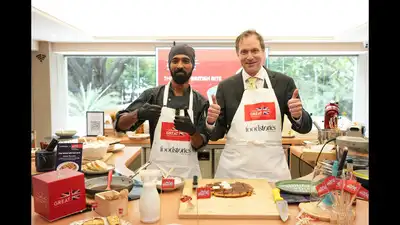
Owen Richards, Deputy Head of Mission, British Deputy High Commission, Bengaluru along with Chef Samson Nitish Roy
“I think you brought a lot of spices and interest to our food,” he says. He recalls that as a boy, Indian food in Britain was simply “curry”. India itself, he says, is comparable to “Western Europe. His first posting was in Mumbai in the early ‘90s, where he ate out constantly because the food was “wonderful”. He says, “My father was a great cook and he used to spend hours making meat pies so it would be soft and flavoursome. “There’s a lot of subtlety in dosa and idli , and it’s a very nice way to start the day,” he states.
A spoonful of curry, a slice of cheddar or a steaming cup of chai — food has long been one of the most delicious ways Britain and India have influenced each other. A recent gathering led by the UK Government’s Department for Business, Innovation, Science and Trade (BIST) brought British ingredients and food traditions into conversation with Indian kitchens. Beneath the tasting plates and marinades was a bigger conversation — not about what Britain brought to India or India gave Britain, but about how food travels, evolves and acquires new meanings along the way. The familiar story of British-Indian food can sound like a one-way exchange: the British arrived, and Indian ingredients and dishes entered British life. Owen Richards, Deputy Head of Mission at the British Deputy High Commission in Bengaluru, sees it differently. “We needed it. He adds that “ chicken tikka masala sits comfortably in the British culinary imagination alongside fish and chips. It’s got that size and variety and even more languages, more cuisines. And the more he learns, the more aware he is of what he doesn’t know. “The more you know, the more you realise you need to know more. We’re just beginning, really, our understanding of the complexity of Indian food. Owen Richards has a simple confession: “I love cooking. He traces his love of cooking not to Britain, but to necessity abroad. When he moved to Geneva, he tried to maintain the habit and nearly went broke. “I realised I was eating my entire salary. So I got a cookbook by Nigel Slater. It has a thirty-minute recipe collection, right from vegetarian meals to meats, fish and desserts,” he recalls. That accidental culinary education turned a diplomat into a home cook. But ask him about the aroma that transports him straight back to Britain, and the answer isn’t a grand banquet. It’s his father’s kitchen. But he also had a sweet tooth. I remember watching him boiling sugar with various essences of mint. So if I smell that, I’m immediately transported back to our kitchen. As for the Indian dish he has loved the longest, it dates back to that first Mumbai posting: pav bhaji . These days, living in the South, he has developed an appreciation for the subtlety of local staples. Worcestershire sauce: A savoury ingredient widely used in sauces, marinades and continental-style cooking.
Today, he knows the difference between cardamom, cinnamon and star anise — and how the order in which spices hit the pan can change a dish.