
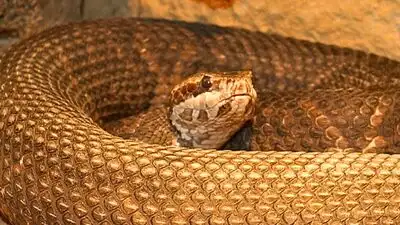
PC: Wikipedia
Oklahoma is home to 46 snake species, seven of which are venomous.
Their eyes have elliptical pupils that help them see, according to the Oklahoma Department of Wildlife Conservation. The seven species belong to a group known as pit vipers and share several physical and behavioural traits. Their heads are wider than their necks and are triangular. Their back and side scales are keeled, meaning each scale has a raised ridge in its centre. Each has a pair of heat-sensing pits between the eyes and nostrils. These pits help the snakes hunt by following heat trails left by prey. Many can also be distinguished by rattles on their tails. The poster from the Oklahoma Department of Wildlife Conservation identifies seven venomous snakes in Oklahoma that are Prairie Rattlesnake, Timber Rattlesnake, Copperhead, Western Massasauga, Western Diamond-backed Rattlesnake, Western Pygmy Rattlesnake, and Western Cottonmouth. All belong to the pit viper group. Their eyes have elliptical pupils that help them see. PC: Wikipedia The Prairie Rattlesnake can be found in rocky outcrops, canyons, open grasslands, and prairie dog towns.
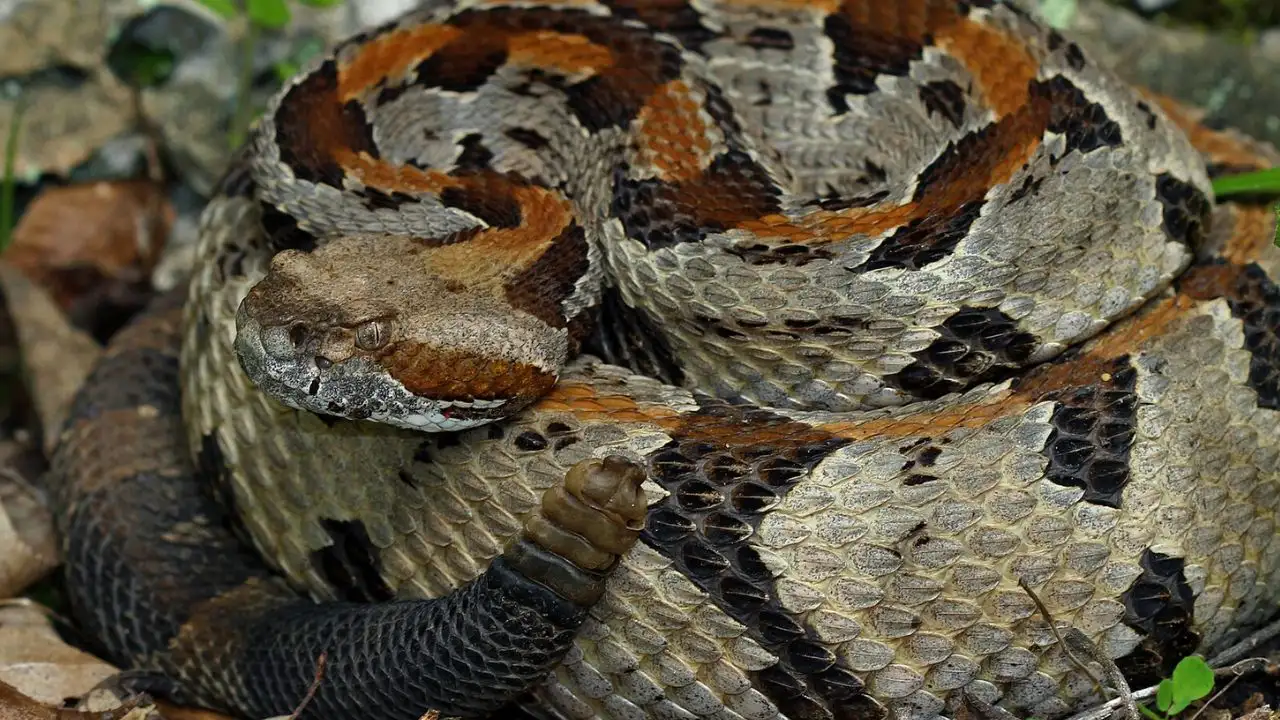
Adults range from 34 to 45 inches. Adults range from 30 to 72 inches, and it is the largest venomous snake in Oklahoma. The Copperhead can be found in a wide variety of habitats, and adults range from 22 to 36 inches.
It spends days in rodent burrows. Its background colour is grayish-brown or yellowish-brown, often with a greenish cast. Brown blotches with dark edges run along the middle of the back, changing to dark brown bands on the tail. The tail has large rattles; the belly is white. The Timber Rattlesnake can be found in forested habitats from rocky, wooded hillsides to swampy wetlands. Its colour varies from nearly black to light yellowish-tan, with bar-shaped or rectangular cross bands on the back half and dark blotches near the head. The Western Massasauga, also called the ‘sand rattler’ or ‘ground rattler’, can be found near wetlands and prairie hillsides. It has a light grayish-brown background, dark brown blotches edged in white along the centre of the back and smaller blotches on each side. Its small rattles make little sound. The Western Diamond-backed Rattlesnake can be found in arid areas, rocky outcrops, and bluffs. It has dark, diamond-shaped blotches edged with white along its grayish-brown back. Its tail has bold black and white bands. The Western Pygmy Rattlesnake can be found in oak woodlands or mixed oak-pine forests. Oklahoma has three subspecies that are Broad-banded Copperhead, Osage Copperhead, and Southern Copperhead. Their bodies have alternating light and dark bands. The darker bands are copper or reddish-brown and hourglass-shaped. Juveniles have a yellow tail tip. The venom is rarely fatal but causes local tissue damage. The Western Cottonmouth can be found in swamps, marshes, and wetlands, along streams or around permanent water such as ponds. You use AI every day. Now get your AI Quotient. Take the AIQ test.