
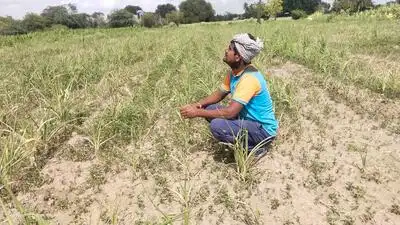
Kolhapur/Nashik: Their crops are stunted, soybean pods are empty and the rain has stayed away for weeks. Yet farmers in several drought-prone pockets of Maharashtra find themselves outside the state’s drought map. Their anguish has put the spotlight on what experts and farmers call a key flaw in the assessment: Govt counted rainfall taluka-wise, allowing better-rainfall pockets to mask severe drought in villages just a few kilometres away.
State govt has declared 265 of Maharashtra’s 358 talukas drought-hit and announced 12 relief measures. The issue of borderline talukas, where revenue circles qualify but not talukas, is largely in Pune division, where 35 out of 58 talukas have been declared drought-hit and the rest left out. In Konkan, 12 talukas are on the list out of 50.
Almost all of north Maharashtra, Marathwada and Vidarbha talukas have been declared drought-hit, barring a few. For instance, only Mukhed and Mudkhed in Nanded district have been left out in Marathwada. Even pockets in Chandwad (Nashik), Tasgaon, Kadegaon and Khanapur (Sangli) and Koregaon (Satara) have missed the first list despite sharp rain deficits and crop distress on the ground.
But its Waiphale revenue circle has received just 66.5%, or around 284mm. By itself, Waiphale meets the rainfall threshold for Trigger 1. Five revenue circles recorded a dry spell of 21 days. Mahabaleshwar, for instance, has received 66% of its normal rain and is on the drought list. But that 66% translates into a whopping 3,557mm. The Sept 23 cut-off has created another problem. Kadegaon in Sangli was marginally above 75% of normal seasonal rainfall when govt took its data. By Sept 27, it had slipped to 74%, putting it below the Trigger 1 seasonal rainfall threshold. Satara’s Koregaon, at 76%, is also on the borderline. In 2023, govt initially declared drought in 40 talukas. After protests, a ministerial sub-committee expanded relief to 1,021 revenue circles, though the decision came only in Nov. “There are five to six such talukas left out in Trigger 1.
In Tasgaon, for example, the taluka as a whole has received around 100% of its normal seasonal rain and is, therefore, outside the drought list. Because their taluka as a whole does not meet the criteria,” he said, it would give a clearer picture and ensure justice to farmers who are suffering but are excluded. Each farmer suffering due to drought will get relief,” he said.
You Can Also Check: Gold Rate in Kolhapur | Silver Rate in Kolhapur | Bank Holidays in Kolhapur | Public Holidays in Kolhapur Stay updated with the latest Kolhapur news.
Officials said revenue circles are not specifically mentioned in Centre’s drought manual. Farmer Satish Nimbalkar said soybean pods may look healthy from outside but have no grain inside. Declaring an entire region non-drought merely on the basis of automated rain gauge figures fails to reflect the real situation on the ground,” he said. A retired senior agriculture department officer said revenue circle-wise assessment would remove much of this ambiguity. Congress MLA Vishwajeet Kadam said. After the crop situation assessment, these talukas will be included and relief will be provided,” he said. Sangli guardian minister Chandrakant Patil said satellite studies and physical verification would follow. Farmers in Chandwad will also get the same treatment as others,” he said.
The problem lies in the yardstick. Govt sought rainfall deviation data for an entire taluka instead of individual revenue circles, or clusters of villages. However, the state already records rainfall separately for every revenue circle. This yardstick can produce glaring anomalies. When merged with the rest of Tasgaon, its deficit disappears in the average. Nashik’s Chandwad presents another anomaly. Eight received only scanty showers. Farmers say these brief spells of rain did little to revive crops. But they technically broke the continuous dry spell used for assessment, helping keep Chandwad off the first drought list. Farmers, however, say their fields tell a different story. “Wonder what you saw during the field visit. Green does not mean the crop is healthy. Stunted growth is clearly visible across villages. Yet Chandwad is missing from the drought list. How is that possible?” asked farmer Keshav Nikam, referring to field visits by guardian minister Girish Mahajan and MLA Rahul Aher. “What kind of technical assessment is being done from offices? Experts say another problem is the use of the percentage of normal rainfall without adequately looking at how much rain actually fell. In comparison, Koregaon has received 470mm, Tasgaon 428mm, Kadegaon 384mm and Khanapur just 353mm. Yet these four talukas are outside the list. But it remains outside the list. “Rainfall and cropping patterns are recorded for every revenue circle. There should be no difficulty in declaring drought circle-wise. Questions are now being raised politically too. “I have sought a written reply from the Sangli collector on why key drought-prone talukas such as Kadegaon, Khanapur and Tasgaon were left out. Why was this changed? Govt insists the current list is not final. Chief minister Devendra Fadnavis acknowledged complaints about exclusions. “Farmers in talukas where drought has not been declared should not worry. District agriculture officer Ravindra Mane offered similar assurance to Chandwad farmers. “The list is not closed. Panchanamas and detailed studies of ground conditions will lead to additions of regions that have been left out. Download the TOI App.
Farmers also question why the state could not follow the revenue circle approach when it has done so earlier. Drought was earlier declared revenue circle-wise.
Experts argue that waiting a few more days for the June-Sept rainfall cycle to end would have given govt a clearer picture, particularly when actual compensation is expected only later in October.