
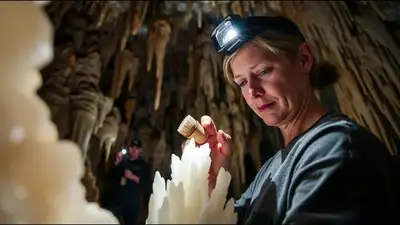
Representative Image of volunteers cleaning the Talus Room in Lehman Caves, removing lint and debris from fragile formations (AI Generated)
More than 30,000 people enter Lehman Caves at Great Basin National Park in Nevada each year, and every visitor unintentionally leaves behind a small amount of material.
The National Park Service says that this material builds up over time, forming a layer of lint and dust on cave formations and walls. NPS says volunteers also dig out debris and sand that were originally brought into the cave for old trails. Fibres from clothing, hair, skin cells, dirt from shoes and objects that fall from pockets can accumulate inside the cave. NPS identifies several potential effects, including contributing to the dissolution of formations, creating unnatural odours, providing an artificial food source for cave life and affecting the cave’s natural appearance. To reduce these human impacts, the park holds an annual lint and restoration camp in which volunteers work inside the cave. The programme is conducted during winter, when the cave is drier and there are fewer tours. The work is much more detailed than an ordinary cleanup. During lint camps, volunteers work in different sections of Lehman Caves, with some teams picking fibres from formations while others remove hair, trash and accumulated material around the trail.
NPS gives the room dimensions of about 90 feet wide and 376 feet long, with a floor area of roughly 21,511 square feet. The park’s historical account records that the Talus Room was removed from the regular tour route in 1981, while another NPS page states that the section was closed to the public in 1983 after a roughly two-cubic-foot rock fell from the ceiling. NPS says that in 2024 maintenance staff removed old stairs and constructed a larger viewing platform at the Sunken Garden area. NPS had identified lint curbs as part of its planned cave-management measures as early as 2017, and a five-year infrastructure project involving lighting, lint curbs and other improvements began in 2019. In January 2024, 29 participants took part in a Lehman Caves Lint Camp and contributed more than 300 hours of volunteer service over three days. With more than 30,000 people entering Lehman Caves each year, the park’s annual restoration effort demonstrates how small amounts of material left behind by individual visitors can accumulate into a conservation issue inside a fragile underground environment.
This restoration work has uncovered rimstone dams and flowstone that had been buried beneath the material for decades. Volunteers may also remove algae growing near artificial lights, which the park identifies as an unnatural food source for cave organisms. The camps allow the park to address several forms of human impact at the same time, while allowing volunteers to work in parts of the cave that are not normally accessible during public tours. One of the areas volunteers can access during lint camp is the Talus Room, the largest room in Lehman Caves. The room remains closed to regular visitors, making restoration work there an unusual opportunity to enter the area. NPS also records that nails, coins, a pool hall token and historic signatures have been found during work in the cave. The National Park Service treats lint removal as one part of a much broader effort to protect Lehman Caves. The park has worked to remove obsolete infrastructure and debris, address algae associated with artificial lighting and restore aspects of the cave’s natural conditions. A major infrastructure project also incorporated measures designed specifically to keep visitor-generated lint away from formations. The platform includes short barriers called lint curbs, which are intended to keep lint on the platform rather than allowing it to move onto cave formations. The park’s recent records show that lint removal remains an active conservation activity. A smaller additional lint camp was held two weeks later. NPS has also documented volunteers working with blacklights to locate lint in areas such as the Lodge Room and Grand Palace, alongside other restoration tasks. The park’s broader cave-management programme includes separate biological monitoring and measures to prevent the spread of white-nose syndrome among bats, but those activities should not be confused with the specific tasks of lint camp volunteers. You use AI every day. Now get your AI Quotient. Take the AIQ test.