
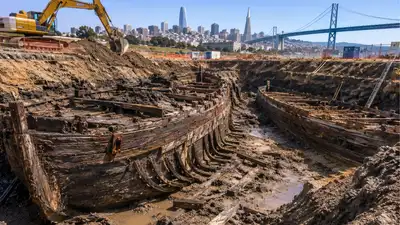
Two ships, more than 100 years old, lay buried beneath a neighbourhood until sewer work uncovered them (representative image). Image Credits: ChatGPT
That’s what happened in San Francisco in early February 2011. Both were buried about 15 feet or 4.5 metres below the ground. Alma, an 1891 scow schooner, shows the kind of vessel that once moved goods around San Francisco Bay.
Maritime museum staff came over and confirmed what the team suspected.
Archaeologists monitoring a sewer improvement project in the Sunnydale neighbourhood of Visitacion Valley found two vessels, a scow schooner and a barge, according to the San Francisco Public Utilities Commission (SFPUC). Imagine a sewer crew digging a trench and hitting a ship. When found, both were more than a hundred years old. A routine job takes a strange turn The idea behind this project was to upgrade old sections of the sewer pipe. Archaeologists from the Far Western Anthropological Research Group were present at the location to watch for any signs of the past history of the city. Then a backhoe pulled up wooden pieces, and the project was put on hold for some time. Historical archaeologists R. Scott Baxter and Rebecca Allen, working with Environmental Science Associates, discovered posts, planks, a support beam, and large pieces of wood. They had uncovered a portion of a scow schooner. The stern, or back end, lay inside the trench, but the bow or front end, remained buried outside it. Soon the archaeologists found a second ship nearby, a wooden barge. Image Credits: Wikimedia Commons The flatbed trucks of the bay
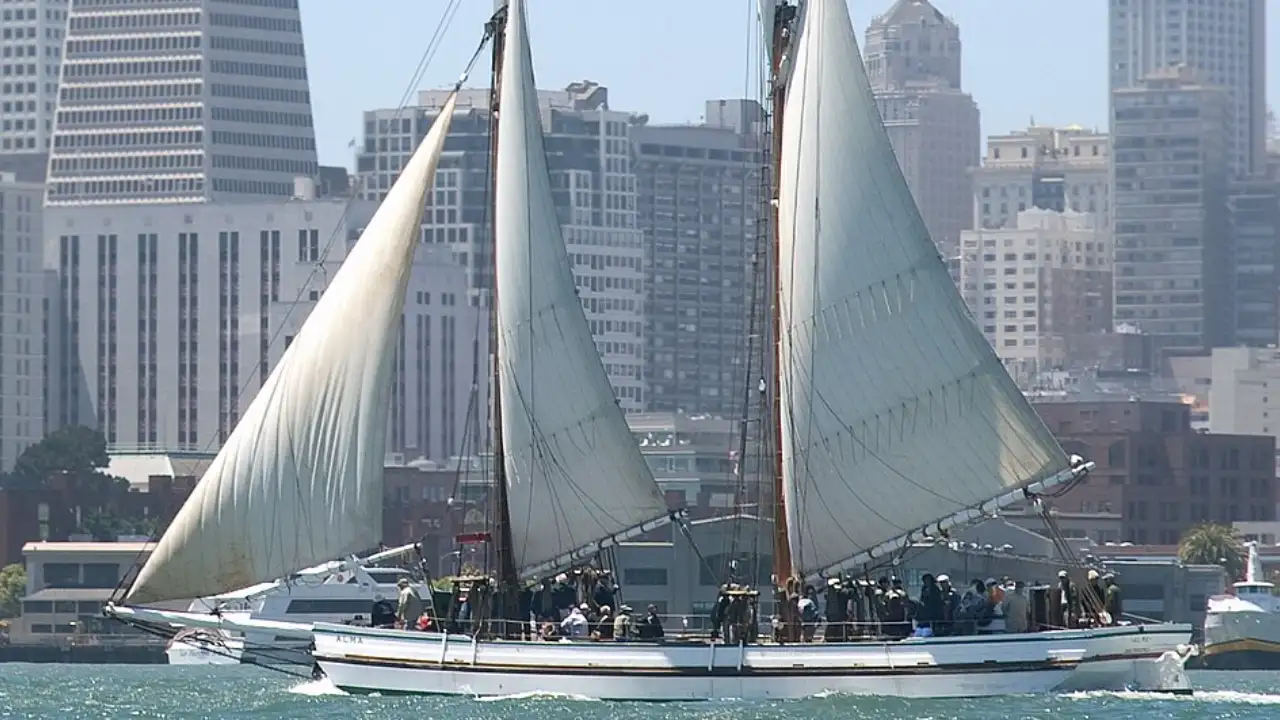
The National Park Service described a real-life example in the scow schooner Alma, built in 1891. In 1918, her masts were removed, and she was towed as a barge, hauling sacks of salt. A photograph taken from the air in 1938 showed that the small cove to the south of Candlestick Point had already been filled in. Near the cove, a ship of about the same size as the scow schooner found in 2011 was also visible, and the agency’s page suggests it could be the same vessel.
These two ships helped supply San Francisco in the late 19th and early 20th centuries. The utility’s write-up notes that the scow schooner probably carried hay, lumber, and bags of salt, while the barge may have carried barley, wheat or anything else the growing city needed. It recorded that she carried hay and lumber under sail. Jim Delgado, the author of Gold Rush Port: The Maritime Archaeology of San Francisco’s Waterfront, described scow schooners as flatbed trucks of San Francisco Bay. He added that they are largely forgotten now, yet they moved the goods that built the city and the Bay Area economy. How the shoreline grew over the wrecks The team studied the site to find out more about how and why the ships were buried. For thousands of years, the site, located on the western side of San Francisco Bay, was underwater. It was the floor of a small cove which Native Americans likely used to harvest oysters and other food items. During the Gold Rush era, the area was still submerged. However, as the city expanded, so did its shoreline, since fill and other debris were dumped into the bay. With the emergence of railroads and cars, which became the means of delivery of cargo instead of ships, abandoned ships started accumulating around the shores of San Francisco. Many abandoned ships were visible, anchored to the east. Recycled one last time Back in the 1930s, Candlestick Cove was a ship-breaking site. Ships were beached and stripped of valuable wood, metal and other recyclable materials. The wrecks were often burned and abandoned, crumbling into rubble to form new land. Both ships were what was left of broken, salvaged vessels. The timbers were waterlogged and decayed rapidly when exposed to air. So, the archaeologists had to record both ships in place, noting construction details and learning about building techniques. Team leader Dr Brian Byrd called the discovery an exciting and important once-in-a-lifetime experience. As the SFPUC frames it, the discovery captured a moment of change, when railroads, trucks, and automobiles replaced scow schooners and barges. You use AI every day. Now get your AI Quotient. Take the AIQ test.