

That does not mean every traditional dish was “invented because of climate”. India’s food map is also a map of its landscapes. What grows in a region, how much water is available, how humid the air is and how easily food can be preserved have all influenced what communities put on their plates. Food traditions are shaped by culture, religion, trade and migration too. But across India, there are striking examples of communities making ingenious use of what their environment offered. From desert berries to rainfed millets and foods preserved over smoky hearths, these dishes tell stories of adaptation.

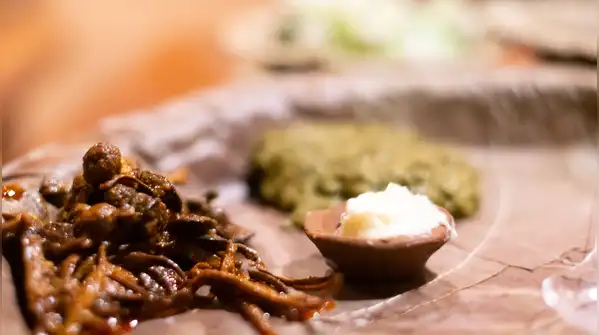
Ker sangri is perhaps one of the clearest examples of desert food culture. Ker berries and sangri, the dried pods of the khejri tree, are gathered, dried and cooked into a dish that can be stored for long periods. In a landscape where fresh vegetables can be difficult to grow consistently, dried, locally available ingredients became valuable pantry foods. Rajasthani cooking consequently developed a strong repertoire of dried vegetables, pulses and preserved ingredients. Roasted gram flour, or sattu, is one of those foods that makes practical sense in a hot climate. It can be stored as a dry powder and quickly turned into a drink or meal by mixing it with water, salt, spices or jaggery. The cooling reputation of sattu is part of its cultural identity, but it is worth avoiding the simplistic claim that it literally lowers body temperature. Its greater significance is that it is portable, inexpensive, requires little cooking and can be prepared quickly during hot weather. Sattu has long been associated particularly with Bihar and neighbouring regions. Rice is central to Odisha, but during the hotter months it often appears in a particularly refreshing form: pakhala, cooked rice soaked or fermented in water and eaten chilled or at room temperature with accompaniments. Its appeal makes sense in a hot, humid environment where a light, water-rich meal can be easier to eat than a heavy dish. The broader tradition of fermented foods is also well documented across India, where communities have used natural fermentation to preserve ingredients and transform cereals, vegetables and other perishables. In the Northeast, bamboo is not simply a building material. Its young shoots are also an important seasonal ingredient, appearing in fermented preparations across communities. Research documented through FAO’s agricultural database describes fermented bamboo shoots as deeply rooted in the food traditions of northeastern India. Research has also documented methods for processing fermented bamboo shoots for culinary use. In a region known for heavy rainfall and humidity, fermentation offered communities another way to preserve seasonal produce.
The Northeast’s smoked-meat traditions are another striking example of preservation shaped by surroundings. In many communities, pork and other meats have traditionally been cured and smoked over household hearths. The humid climate made keeping fresh meat for long periods difficult before refrigeration. Smoke, salt and time provided a practical preservation method. Traditional homes with continuously burning hearths could effectively double as spaces where meat was slowly smoked and preserved. Ragi, or finger millet, has been a major traditional grain in Karnataka and other parts of peninsular India. The grain is well adapted to a range of environmental conditions, and much of its cultivation in India is rainfed. Karnataka accounts for a particularly large share of India’s finger-millet cultivation. That agricultural resilience helps explain why foods such as ragi mudde became deeply embedded in regional food culture. In places where rainfall can be uncertain, a dependable rainfed grain can become the foundation of everyday meals. Kerala’s cuisine demonstrates how proximity to water can shape an entire food culture. Rice, tapioca and fish have long been important components of the diet, with marine and inland aquatic resources readily available. FAO’s study of Kerala’s fisheries explicitly links the state’s aquatic ecology with its longstanding fish-eating traditions. Here, adaptation was not about surviving scarcity alone. It was also about making the most of a rich local ecosystem.