
‘Learn it the hard way’: Why Chinese parents are paying thousands for ‘hardship camps’ for their children to learn important life skills
Past generations remember hardship, as many parents and grandparents survived times when food and warmth were rare. They credit those trials for building resilience, and now fear a cushy upbringing makes their own kids soft. Tong Lu, founder of Haoshi, said that children today don’t really grasp what it takes to earn a living or make a meal.
Children can spend three to four hours gathering, bundling and carrying firewood in baskets, only to use it to prepare a meal that takes around 10 minutes to eat, according to CNA. Ten days costs around 5,000 yuan (about US$700); month-long stays push past 10,000 yuan. Take the ‘Swapped Lives’ camp, for example, run by Haoshi Study Tours deep in the Zhejiang mountains. For six days, nine- to twelve-year-olds work alongside local farmers, gathering firewood for hours just to cook a quick meal. They also pick tea leaves, which can be exchanged for food supplies donated to disadvantaged families. In fact, picking tea leaves isn’t just an activity; it’s currency, exchanged for supplies that go to poor families. Cleaning cow stalls? Just ten to twenty minutes, but the dung becomes fertilizer or fuels biogas. One particularly grueling challenge is having kids carry a kilo of rice up a mountain before eating simple rice outside an abandoned school. Despite the rustic setup, the camps don’t come cheap. Kids bunk together, with six to eight of them in every room, in basic beds. Phones? Taken away upfront. Camps operate on a points system: complete tasks, earn credits, exchange for food and toiletries. Sometimes, if you don’t rack up enough points, you eat plain potatoes for dinner. That’s led critics to question whether genuine hardship is getting muddled with punishment.
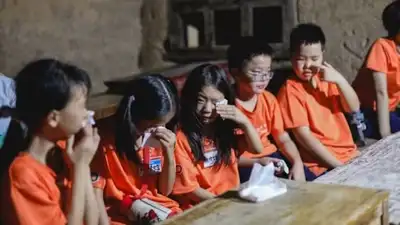
Per the South China Morning Post, by summer 2026, these hardship camps were trending big time, especially as videos of homesick, teary-eyed kids circulated online. Parents fork out anywhere from 5,000 yuan (approximately US$700) for ten days to over 10,000 yuan for a month. their popularity surged during the summer of 2026 Although similar programmes have existed since the early 2000s.
The phrase “eat bitterness” is deeply woven into Chinese culture: it’s the belief that going through tough times can shape character and help people appreciate what they have. Think about this for a minute: Chinese parents living in city apartments, surrounded by gadgets and comfort, will spend thousands of yuan to send their kids somewhere rural. No Wi-Fi, no phones, definitely no air-conditioning. Instead, the kids spend their summer sweating in cow sheds, hauling firewood, cleaning up after livestock. The idea behind it is as unusual as the activities themselves: parents want their children to experience hardship so they learn to appreciate the comfortable lives they have grown up with. Most campers are between six and sixteen years old, as the programmes promise to teach discipline, independence, gratitude and resilience through manual labour and a temporary departure from urban comforts. And while it started with a few adventurous families, now it’s a heated national debate: is struggling on a farm really the best way to build resilience? For starters, chi ku isn’t some new-age experiment. These camps take that philosophy and serve it up to urban kids who are used to city comforts, often in rural regions like Sichuan, Yunnan, and Guizhou, where children are temporarily immersed in agricultural life. Most camps are run by private companies, not schools. Their pitch? Strip away the luxuries and plunge the kids into country life. Kids wake up early, pick tea leaves, dig potatoes, chop wood, scrub cow stalls, and if they don’t finish chores, there’s no swapping them for snacks or screen time. Some camps make them cook for themselves, old-style, over an earthen stove, with barely any seasoning.