
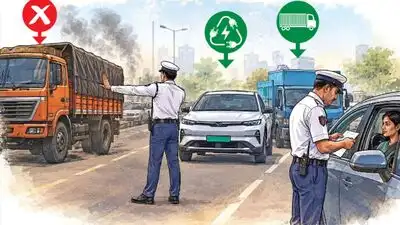
Delhi is set to introduce new vehicle restrictions aimed at reducing pollution in the city (AI image)
Vehicles registered outside Delhi and conforming to BS-IV or lower emission standards, including petrol and diesel vehicles, will be banned from entering Delhi between November 1 and January 31. For N1 light goods vehicles , which are used for carrying goods and have a gross weight of up to 3,500 kg, Delhi will stop registering diesel, petrol and CNG variants from January 1, 2027. The restriction will extend to high-vehicle-density NCR districts, including Gurgaon and Noida, from July 1, 2027. For the heavier N2 category , covering vehicles weighing between 3,500 kg and 7,500 kg, Delhi will allow only electric variants to be registered from January 1, 2028. In Gurgaon, Faridabad, Sonipat, Ghaziabad and Noida, the electric-only requirement will begin on July 1, 2028. In the rest of NCR, only electric and CNG N2 vehicles will be allowed to be registered from January 1, 2029. Electric three-wheelers in the L5 category — passenger and goods vehicles with a maximum speed of up to 55 kmph and weight of up to 1,500 kg — will also be introduced through a phased registration schedule. Delhi will allow their registration from January 1, 2027. The same will be permitted in Gurgaon, Faridabad, Sonipat, Ghaziabad and Noida from January 1, 2028, followed by the rest of NCR from January 1, 2029. Motor vehicle aggregators, delivery service providers and e-commerce companies will face tighter fleet requirements from 2027. From January 1, 2027, these entities will not be allowed to induct conventional internal-combustion-engine vehicles running purely on petrol or diesel. For existing fleets, BS-VI emission-standard two-wheelers can be inducted only until December 31, 2026. Delhi implemented the ‘No PUCC, no fuel’ rule in 2025. The measure will be extended to the rest of NCR from October 1, 2026. CNG continues to generate significant quantities of nitrogen oxides (NOx) , which are important precursors to the formation of secondary PM2.5. A TERI analysis from 2022 estimated that vehicular NOx accounts for 18-22% of the total NOx load in the NCR airshed, with CNG fleets contributing a substantial share. Secondary particulates, meanwhile, are among the largest identified contributors to ambient PM2.5 concentrations in Delhi-NCR, accounting for around 27% in winter and 17% in summer .
As a result, continued reliance on CNG can shift some pollution from directly emitted exhaust particles towards chemically formed secondary particulate matter rather than eliminating particulate pollution altogether. You Can Also Check: Gold Rate in Delhi | Silver Rate in Delhi | Bank Holidays in Delhi | Public Holidays in Delhi | Delhi AQI | Weather in Delhi | Petrol Price in Delhi | Diesel Price in Delhi | CNG Price in Delhi | LPG Price in Delhi Stay updated with the latest Delhi news. NEW DELHI: The city is bracing for another pollution-ridden winter, with authorities tightening restrictions on vehicles and pushing for a gradual shift towards cleaner modes of transport. Several restrictions on vehicle registration, entry and fleet induction are set to come into effect in Delhi and other parts of the National Capital Region (NCR) over the next few years. From curbs on older emission-standard vehicles to a phased shift towards electric vehicles, the new rules will affect private motorists, commercial operators, buses, delivery fleets and even school transport. However, BS-VI, CNG and electric vehicles will be exempt from this restriction. The rules also set out a phased transition for light goods vehicles. Taken together, the measures represent a gradual tightening of vehicle-related rules across Delhi-NCR. Restrictions on older vehicles and conventional commercial fleets are being accompanied by deadlines for electric vehicle adoption in goods transport, two-wheelers, three-wheelers, buses, delivery fleets and school transport. For motorists and fleet operators, the key dates over the next few years will determine which vehicles can enter Delhi, which can be registered and which can continue operating as air-quality restrictions become progressively stricter. Download the TOI App.
From November 1, 2025, commercial goods vehicles other than BS-VI, CNG, LNG and electric vehicles will not be allowed to enter Delhi, except for vehicles registered in Delhi. BS-IV commercial goods vehicles have been given a limited relaxation and will be permitted to enter Delhi only until October 31, 2026. From November 1, 2026, buses entering Delhi, including those operating under All-India Tourist Permits and other service regimes, will have to be either CNG, electric or BS-VI diesel. A major change for individual vehicle buyers is scheduled for April 1, 2028. Schools will also have to progressively electrify their vehicle fleets under EV Policy 2.0 , which was notified on June 30. The policy sets a minimum electric share of 10% of the fleet by the end of the second year from notification, rising to 20% by the end of the third year and 30% by March 31, 2030.
Under the system, vehicles without a valid Pollution Under Control Certificate (PUCC) will not be eligible to purchase fuel. Commercial goods vehicles entering Delhi will also face tighter restrictions. The restriction will not apply to buses registered in Delhi. At the same time, the Delhi Transport Corporation (DTC) and the transport department will procure only electric intra-state buses, further accelerating the transition towards electric public transport. From that date, only electric two-wheelers will be permitted for new registration in Delhi. The move is part of the broader effort to gradually reduce dependence on conventional internal-combustion-engine vehicles. Authorities in Delhi-NCR can take action against end-of-life vehicles conforming to BS-III or lower emission standards. The measure adds to the existing efforts to remove older and more polluting vehicles from the region’s roads.
Why vehicular pollution is being targeted
During Stage I , when the Air Quality Index (AQI) is between 201 and 300, and Stage II , when it is between 301 and 400, inter-state and inter-city buses from Haryana, Uttar Pradesh, Rajasthan, Punjab, Himachal Pradesh, Madhya Pradesh, Uttarakhand and Jammu & Kashmir will not be allowed to enter Delhi unless they are electric, CNG or BS-VI diesel vehicles. When the AQI reaches Stage III , or 401-450, BS-III petrol and BS-IV diesel light-motor vehicles, including four-wheelers, will be restricted in Delhi, Gurgaon, Faridabad, Ghaziabad, Sonipat and Noida. The strictest restrictions apply under Stage IV , when the AQI crosses 450. A CAQM meta-analysis of studies conducted between 2015 and 2025 estimates that transport contributes 19-24% of pollution during winter and 18-21% during summer .
The Graded Response Action Plan (GRAP) introduces progressively stricter restrictions as air quality deteriorates. At this stage, diesel-operated medium goods vehicles conforming to BS-IV or lower standards will also be restricted in Delhi. BS-IV and below diesel-operated light commercial vehicles registered outside Delhi will not be allowed to enter the capital. Truck traffic entering Delhi will be banned, with exemptions for LNG, CNG, electric and BS-VI diesel trucks. Delhi-registered diesel-operated BS-IV and below heavy goods vehicles will also be prohibited from plying in the city. Transport remains a significant contributor to air pollution in the Delhi-NCR region. The figures have made vehicular emissions an important focus of the region’s pollution-control strategy, alongside measures targeting other major sources of pollution. The shift from diesel to CNG can substantially reduce primary particulate emissions, but CNG vehicles are not entirely pollution-free.