
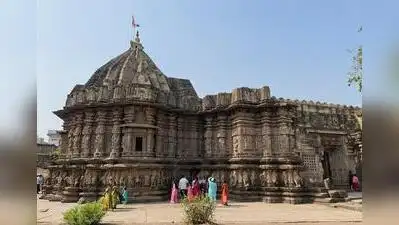
Kopeshwar temple at Khidrapur in Shirol tehsil of Kolhapur district
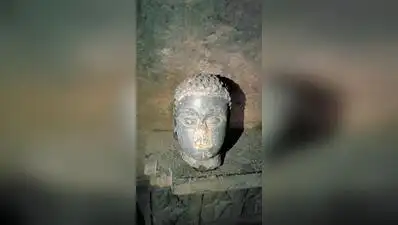
A solid stone bust, which could be of Buddhist or Jain origin, was found at a mound inside the premises of Kolhapur’s Kopeshwar temple at Khidrapur A solid stone bust, which could be of Buddhist or Jain origin, was found at a mound inside the premises of Kolhapur’s Kopeshwar temple at Khidrapur Kopeshwar temple at Khidrapur in Shirol tehsil of Kolhapur district A solid stone bust, which could be of Buddhist or Jain origin, was found at a mound inside the premises of Kolhapur’s Kopeshwar temple at Khidrapur A solid stone bust, which could be of Buddhist or Jain origin, was found at a mound inside the premises of Kolhapur’s Kopeshwar temple at Khidrapur Kopeshwar temple at Khidrapur in Shirol tehsil of Kolhapur district Kolhapur : For centuries, the magnificent stone sculptures of Khidrapur’s Kopeshwar temple have told their stories in plain sight. Now, something found three feet below the ground is raising questions about a past that may have remained buried. A stone bust, apparently part of a full-sized statue, has been unearthed from a mound inside the premises of the 12th-century Kopeshwar temple in Kolhapur’s Shirol tehsil. others say it may be that of a Jain preacher While some believe it could depict Buddha. If the bust’s identity and antiquity can be established, researchers believe it could offer clues to the area’s religious and cultural history beyond the temple. However, archaeologists are urging caution. A damaged bust alone, they say, does not provide enough iconographic evidence to settle whether the figure is Buddhist or Jain. The sculpture surfaced when a mound of debris was being cleared near the north-western corner of the temple premises. Maharashtra State Road Development Corporation (MSRDC) is carrying out beautification and restoration work, including construction of a compound wall, under the supervision of Archaeological Survey of India (ASI). The same mound has yielded several other sculptures. Among them are a broken Nandi (bull) and a damaged figure of a woman carrying a baby on her hip. Most of the sculptures recovered from the spot are damaged. Buddha or Jain preacher?

The circular pavilion is open to the sky and rests on 48 elaborately carved stone pillars. Its Gajapeetha, or elephant pedestal, features 92 life-sized elephants appearing to carry the massive structure on their backs. However, most of them were damaged during the 2019 and 2021 floods.
The mound could, therefore, just be a cache of rejected and damaged temple sculpture. You Can Also Check: Gold Rate in Kolhapur | Silver Rate in Kolhapur | Bank Holidays in Kolhapur | Public Holidays in Kolhapur Stay updated with the latest Kolhapur news.
In the case of a Jain statue, there would be a ‘Srivatsa’ (a sacred symbol) on the chest of the statue,” said a senior ASI official, requesting anonymity. Desai said the find suggests Khidrapur may once have been a centre of Buddhist philosophy. Legend says King Daksha is believed to have organised a sacrifice where Shiva was insulted, following which Sati sacrificed herself. Legend also says that Shiva’s sacred bull is at Yadur in neighbouring Karnataka, facing towards Kopeshwar.
For now, the bust’s identity remains an archaeological puzzle. “Based on the look of the bust, we cannot suddenly jump to a conclusion as to whether it is that of a Jain preacher or Buddha. Jains had temples and Buddhists had rock-cut caves built. Had we found a full-sized statue, we would have had a better idea. The facial structures are somewhat similar in both cases, but the iconography is distinct. History researcher Subhash Desai, however, believes the bust is most likely that of Buddha. That possibility gives the location particular significance. Finding an apparently Buddhist or Jain figure within its precincts sparks curiosity about the region’s past. A sculptors’ dump? There is another, less dramatic explanation. The north-western corner may simply have become a dumping ground when the temple was being built. Sculptures that broke during carving, or pieces that could not be chiselled into the desired form, may have been discarded there. This theory is based on the condition of the finds. Most of the sculptures recovered from the mound are incomplete, with portions missing. Interestingly, houses belonging to temple priests once stood around the mound. The priests eventually moved away. A masterpiece shaped in stone Standing close to Krishna, Kopeshwar temple, built from black basalt brought from southern India along the river, is remarkable. Its defining feature is the Swargamandapa (Heaven Hall). A circular opening above allows sunlight and moonlight to fall directly into the hall. The temple’s exterior is equally striking. No two are depicted in exactly the same posture. Across its outer walls are thousands of intricate carvings. Gods, celestial nymphs, musicians and mythological creatures crowd the stone surface alongside scenes associated with the Ramayana and Mahabharata. Repeated flooding of Krishna has caused irreversible damage to the historic structure. Concerns over preservation have also reached Bombay high court’s Kolhapur bench through a public interest litigation seeking conservation of the temple and its premises. The court constituted a panel to visit the site, assess its condition and submit a report. The latest discoveries have made the preservation of the precinct even more important. Legend of the temple Kopeshwar also carries a curious distinction. An enraged Shiva was then brought to this tranquil spot to calm down. The name Kopeshwar is linked to Shiva’s rage ( kop means rage). Download the TOI App.
Unlike most Shiva temples, no Nandi sits before the sanctum here. Kopeshwar today is celebrated as a Shiva temple and one of the region’s outstanding examples of medieval stone architecture.