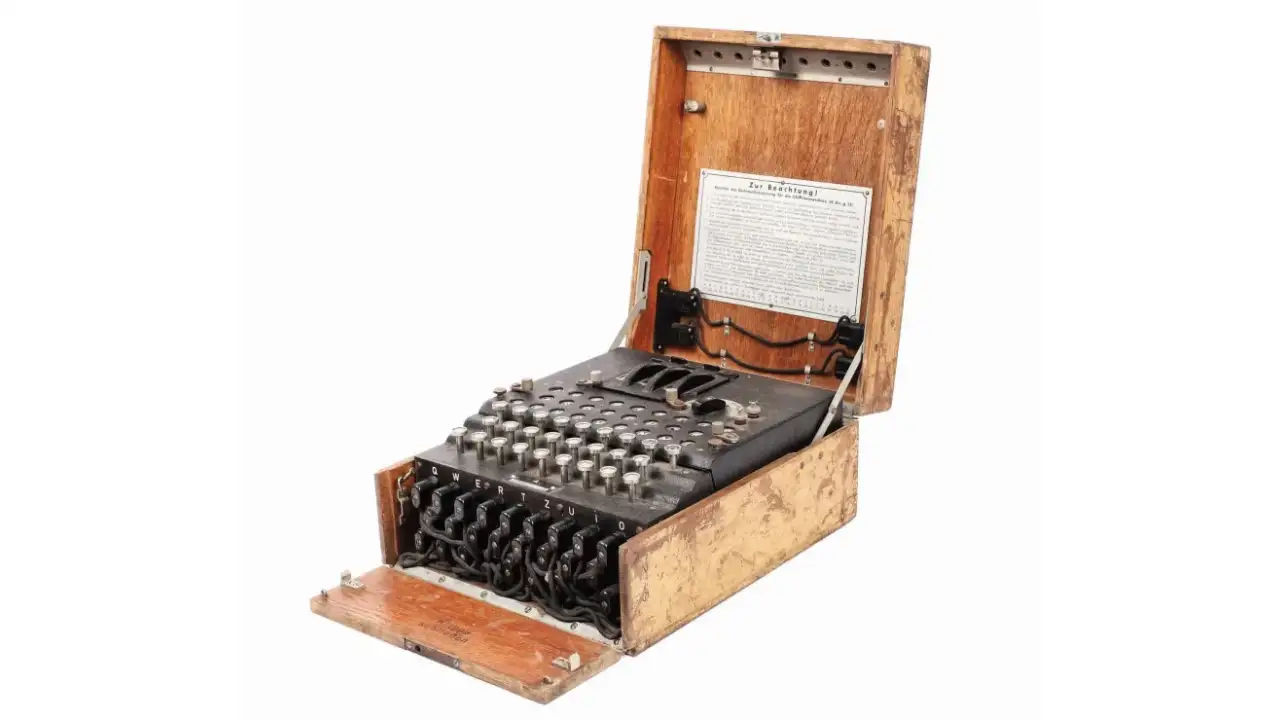
A Romanian flea-market seller thought an old machine was a typewriter and let it go for €100; the buyer, a cryptography professor, recognized a World War II Enigma I and sold it at auction in 2017 for €45,000/Image: Reuters
From a flea market to a €45,000 auction
In 2017, a machine sold for €100 at a Romanian flea market turned out to be a German Enigma I used during World War II , after a cryptography professor recognised what the seller had mistaken for an ordinary typewriter. The rare machine later sold for €45,000 at an auction in Bucharest. He bought it for €100 before eventually consigning it to Artmark, a Bucharest auction house. Artmark put the machine up for sale with a starting price of €9,000. It was eventually bought by an unnamed online bidder for €45,000. World War II Enigma I/Image: Gabriel Ghizdavu/Artmark The machine had been made in Germany in 1941 and was described by an Artmark representative as being in almost perfect condition. Its eventual auction price was 450 times what the seller had received at the flea market. However, the €45,000 sale was not the highest price paid for an Enigma machine. A month earlier, a four-rotor Enigma cipher machine from 1944 had sold at Christie’s in New York for $547,500, according to Reuters. Another Enigma machine featured in a Hollywood film about the Bletchley Park codebreakers had sold in London in 2011 for £133,250, as per the CNN. The machine’s presence in Romania also has a historical connection to the conflict.Romania was an ally of Nazi Germany until 1944, when it switched sides and joined the Allies.
Because the machine was a German Wehrmacht Enigma I, a cipher device used to encrypt military communications during World War II, the discovery was particularly significant.
He’s a cryptography professor and … he knew very well what he was buying,” Cristian Gavrila, Artmark’s collectible consignment manager, told Reuters. Vlad Georgescu, a relationship manager at Artmark auction house told CNN, that collector had spent time cleaning and repairing the machine after buying it. He also said the previous owner had not realised what the object actually was and had believed it to be a conventional typewriter.
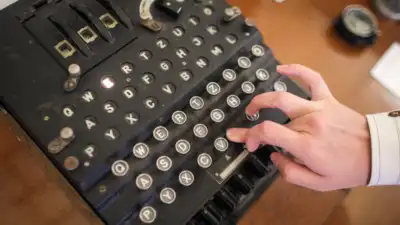
The collector spotted the machine at a flea market and immediately recognised its significance. “The collector bought it from a flea market. The collector, described as a mathematician who had spent much of his life decrypting codes, began examining how the machine worked after acquiring it. The Enigma was an electromechanical encryption device used by different branches of Nazi Germany’s military to encode and decode messages. Operators typed messages using the machine’s keyboard. Its rotors could be set to different positions, changing the encryption produced by the device. Later versions also included a plugboard that added another layer of complexity. German forces believed messages protected by the system were difficult to decipher. That changed during World War II when British codebreakers at Bletchley Park worked to break the Enigma codes. Mathematician Alan Turing was part of the wider codebreaking effort. The work carried out by Turing and his colleagues is widely credited with helping shorten the war. Estimates cited in the supplied reports put the impact at around two years. You use AI every day. Now get your AI Quotient. Take the AIQ test.